
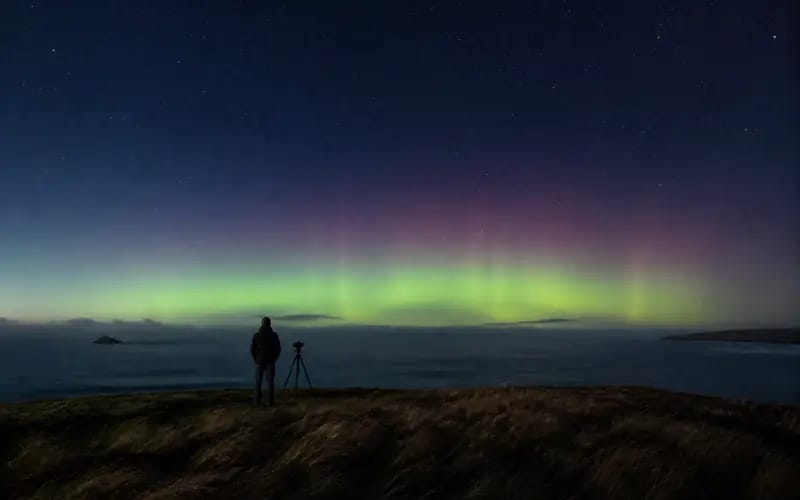
When Can You See the Northern Lights in the UK? Why Autumn Is One of the Best Times to See Aurora to View.
September 23/24 is within one of the better time slots for viewing the Northern Lights from the UK. Two forecasts are required – space weather and normal weather.
What Causes The Northern Lights
A geomagnetic storm is triggered when a larger than normal burst of particles is thrown out by the sun. These travel up to the Earth’s magnetic field and are channelled down to the poles. Within the Earth’s atmosphere, at around 100km up, the particles then collide with the gases within it. These collisions release all of the light, which we see as the beautiful display of colours in the sky. The light is most often seen as green, but can also appear as pink or red depending on the strength of the activity.
Why You Need A Space Weather Forecast
When looking for forecasts of the aurora, normal weather forecasts are of no use. A space weather forecast is needed which tells you about recent and predicted space weather and whether it is likely to trigger a geomagnetic storm of sufficient size to produce visible aurora in the UK. The Met Office space weather forecast provides such information and a link to a page which explains how the aurora borealis (northern lights) forms and what conditions need to be met in order for aurora to be seen this far south. The absence of an active aurora alert on this page means that the chances of seeing any aurora are low regardless of what the rest of the weather looks like.
Why Equinox Weeks Tend To Favour Aurora
Equinox weeks (around the autumnal and vernal equinoxes) tend to see more geomagnetic activity than other weeks of the year. This is because the Earth’s magnetic field is aligned with the Sun’s solar wind in such a way that disturbances are more easily triggered. Late September falls within this favoured window and, although there are no specific events predicted by space weather forecasters, it is often flagged up as a time to try and see the aurora.
Why Cloud And Light Still Matter
Space weather is only half the story. On clear nights the visibility of aurora can be affected by cloud, and by light pollution. The forecast for cloud for your location on the night is as important as the space weather forecast. It is also worth noting that whilst aurora can be seen from all over the country in periods of high geomagnetic activity, displays seen in the south of England are normally of a lesser quality than those seen in the north and west.
Where In The UK Gives The Best Odds
However, Scotland, northern England, North Wales and Northern Ireland are best placed to see the aurora. Further south, the aurora is only visible during very active geomagnetic storms and even then only in extremely clear skies. On moderate activity nights, southern England is not likely to see anything even on completely clear nights.
Practical Tips For Watching
Look north for the aurora. Find a location that is far from streetlights and has an open view to the horizon. Try to avoid going over hills or through woodlands as you won’t know what is blocking your view. Give your eyes 20-30 minutes to adjust to the dark before you go back to your phone. In terms of equipment, just being there and patient is the best thing to observe the aurora.
Try A Phone Camera
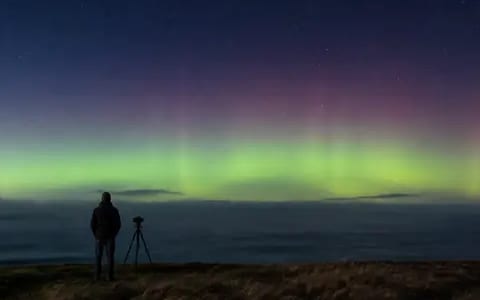
Try to take a photo of the sky with your phone’s camera. Open up the camera app on your phone, switch it to night mode if possible, focus on a big patch of sky and then take a few second exposure shot. Often the colours and structure of the aurora will show up in photos when you can’t see them with the naked eye. So even after half an hour of staring at the sky in vain, it’s worth checking your camera to see if you’ve captured any thing.
Go Or No-Go Decision Framework
Are there any aurora alerts from the space weather forecast on the Met Office website? If not then the chances of seeing anything are low.
Is the sky clear? Check the cloud forecast for where you are. Even slight cloud cover will ruin your attempts at viewing.
Is the location dark enough and far enough away from street lights with a view to the North?
Are you based in Scotland, northern England, North Wales or Northern Ireland? If so, the northern lights are more likely to be visible than if you are based in the south of the country and there to be a strong geomagnetic storm.
Take a photo with your phone’s camera. Set it to take a photo after a few seconds and use the night mode (if available). Often the photos captured by a camera can show up colours and structure that the human eye cannot pick up even when viewing a very faint display.