
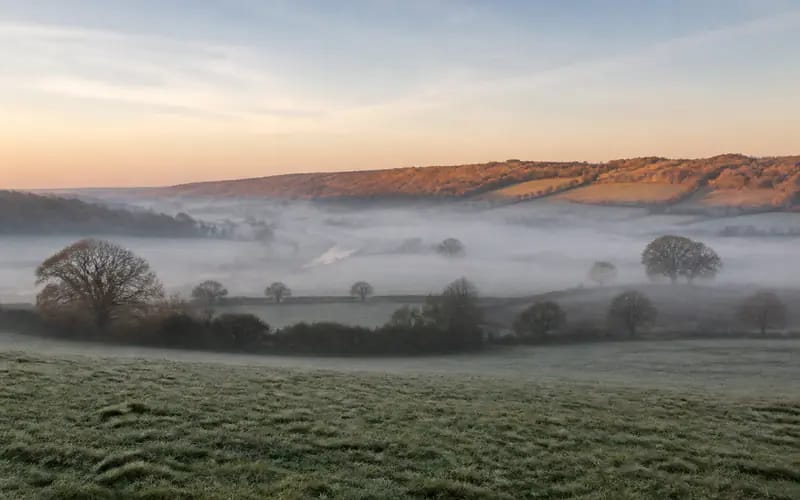
How temperature creates fog – simple explanation! In simple terms, fog forms when the air temperature decreases to allow the water vapour in the air to change from gas to liquid droplets.
What Fog Actually Is
The air contains water vapour and the amount of vapour in the air increases with temperature. The air must cool to a certain temperature before it can hold no more water vapour. This temperature is known as the dew point. When air cools to its dew point, the water vapour in the air condenses into tiny water droplets which form in the air and can fall as precipitation. The water droplets in fog are suspended in the air and form when the air reaches its dew point. The clearer and calmer the weather, the easier it is for the air to cool to its dew point.
Radiation Fog On Clear Autumn Nights
While you are sleepily preparing to head off to work in the morning, thick fog forms over low-lying areas in the form of a shallow layer of water droplets. It usually burns off by mid-morning when the sun has managed to warm up the ground. It’s known as Radiation Fog, and it’s one of the most common types of fog in the country. The ground rapidly loses heat in the clear autumn night, and by dawn the air close to the ground has cooled to its dew point and formed a layer of fog.
Valley Fog And Pooling Cold Air
In hollows, down in valleys, fog will sit for hours. Cool air is denser than warm air, so it will sink. This means that in still conditions, air that has cooled up on hills will slide down and collect in the lowest points of the surrounding countryside. Thus it is possible to drive out of thick fog and within 50m be travelling through clear air. Some villages seem to get fogged up more frequently than others nearby. Often the reason for this is that they are down in a hollow and the surrounding hills are higher.
Advection Fog From Moving Air
Not all types of fog need calm, clear skies. Advection fog is the type of fog that can be travelling down a road on a day that is quite normal. It is caused by a flow of milder, moist air over a colder surface, such as the sea, a wet field or even snow. As the air travels over the surface it loses heat to it and cools to its dew point.
Freezing Fog And Rime
Freezing Fog. Although this form of fog is more typically associated with the colder months, it’s worth mentioning here as it does start to form in the early autumn months. Freezing fog forms when air temp is below 0°C and the water droplets in the air do not freeze but form into small liquid water droplets. These droplets then freeze onto surfaces such as cars, trees, fences and so on to form a thick, white, feathery coat of ice – rime.
How Fog Is Officially Measured
It’s worth understanding the Met Office’s definitions of various weather phenomena that we refer to as ‘fog’ or ‘mists’. They describe mist as being reduced visibility down to 1km to 2km, with fog being below 1km and dense fog below 200m. More information can be found on the Meteorological Office website. These definitions help to influence the decision as to whether or not to use fog lights, which in turn will affect other road users.
The Highway Code Rule On Fog Lights
When driving in foggy weather, fog lights can be very helpful in increasing your visibility to other road users. There are, however, rules surrounding their use. In accordance with Rule 236 of the Highway Code, you can only use front or rear fog lights when visibility is seriously impaired and is less than 100m (just under the length of a football pitch). Remember to switch off your front or rear fog lights when visibility improves.
Common Mistakes In Fog
Mistis generally considered to reduce visibility to between 1,000m and 2km and so is differentiated from fog for measurement purposes. Most of the problems associated with driving in fog therefore only relate to visibility below 1km and it is this that the rules for use of fog lights relate to. However, visibility can drop and then rise in short spaces and therefore there are many patches of fog. In these cases it is easy to assume that the fog has gone because it has in front of you, only to be caught out by another dip in the road further on.