
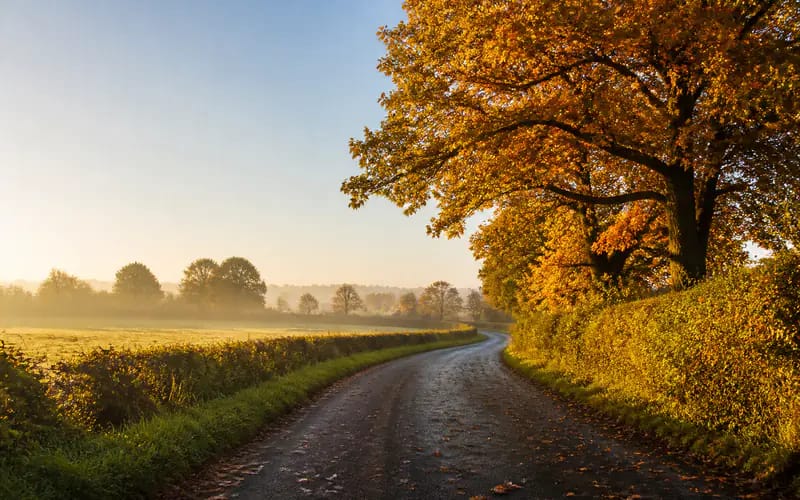
An “Indian Summer” is often referred to when September and October experience a spell of mild, settled and often sunny weather following the first cold snap of the season. So, is this an “Indian Summer”? We look at what actually constitutes an “Indian Summer” and where the term originates from.
What Counts As An Indian Summer
An ‘Indian summer’ is typically characterised by an extended period of calm, dry and sunny weather. This ‘warm interlude’ occurs after the first frost of autumn, or later in the season when there has been a subsequent fall of frost. Such episodes are typically characterised by high pressure and are associated with a sinking column of air that has warmed on its descent through the atmosphere.
Where The Phrase Comes From
In the U.S., an Indian summer is a weather phenomenon of late summer/early autumn when there are periods of warm, haze, and calm weather. The reason for the name Indian summer is not quite clear but in Britain the phrase had become established by the early 20th century. As yet the Met Office have only been able to find one reference to an Indian summer in a 1916 glossary of weather terms.
The High Pressure Behind It
Slow-moving areas of high pressure, or anticyclones, are responsible for the vast majority of warm Indian summer periods of weather that occur over the UK. Under high pressure, air sinks down through the atmosphere. As it does so, it warms up and becomes drier. So, under high pressure we get clear blue skies, light airs and warm to very warm sunshine by day. However, temperatures often fall sharply at night. The Met Office pages on high and low pressure explain in more detail why slow-moving, large high pressure systems bring settled, dry weather and not more changeable weather as is seen under low pressure.
Why Timing Is Part Of The Definition
The other critical aspect of the definition is the timing. So a warm spell of weather in early September is just a mild September, however pleasant. It is not an Indian Summer. It is only after the first frost of the autumn that the weather can break and return to warm, dry, clear weather. This is the exact reverse of the sort of weather that we typically associate with the onset of Autumn and so it is worth noting.
St Luke’s And St Martin’s Summer
There are also traditions of referring to warm periods in the late summer/early autumn as being due to the intervention of particular saints. St Luke’s summeris said to occur in mid-October, and St Martin’s summer in mid-November, around the dates of the two saints’ festivals. These are very ancient traditions and are still found in some old gardening and farming books and traditions.
The Myth, Checked
Despite the fact that St Luke’s summer and St Martin’s summer occur at fixed points on the calendar, there’s no evidence to suggest that warm spells recur on these dates year in, year out. The high pressure systems that bring Indian summers are shaped by the larger weather pattern, the jet stream, and so don’t follow the saints’ days. While some years see a warm spell in mid-October, others see one in November, and yet others none at all. The names for these events are simply a post-event label.
How It Differs From A Heatwave
An Indian Summer is often mistaken for a late ‘heatwave’. There is a big difference however. First of all an Indian Summer only occurs in the Autumn, following a spell of frosty weather. Then there is the warm air, as opposed to the hot air of summer, which makes up for the ‘Summer’ in the name. Finally, the high pressure systems which cause an Indian Summer are not the same as those that cause a late ‘heatwave’. A late ‘heatwave’ is caused by a shift in the jet stream allowing tropical air to flow north into the UK.
When And Why Some Years Get One
Most Indian summers occur between mid-September and early November and can occur only after the first frost of the autumn. Where the jet stream is and whether or not a high pressure system will become ‘blocked’ and stay put for any length of time are factors that can determine whether or not an Indian summer will occur in a particular year or place. If it does occur then it can affect the signs of late warm autumn in woodland and delay the date of leaf fall as well as keeping plants and insects active for longer than usual. The Woodland Trust website gives full details of these signs.
FAQ
Is "Indian summer" an official Met Office term?
It is not an official Met Office forecast category and is referred to as a traditional term that the Met Office defines in order to refer to a warm, calm and clear weather spell of weather following the first occurrence of frost in autumn.
Where does the phrase come from?
It originated in North America and referred to late summer weather, usually hazy and warm, which can occur just before winter sets in. The term had entered British usage by 1916 and was included in an early Glossary of Meteorological Terms.
A slow-moving area of high pressure over or near the UK.
A slow-moving area of high pressure over or near the UK, causing sinking air to warm as it falls to the ground, and resulting in clear and calm weather.
Are St Luke’s and St Martin’s summers real?
The names St Luke’s summer and St Martin’s summer have become embedded in folklore for weather occurring around the saints’ feast days in mid-October and around 11th November respectively. While these names are used, there is no statistical evidence to prove that warm weather of any description occurs on these dates year after year.