Ask any teacher what happens when a new craze hits the playground and they will give you the same answer: it's like watching a field catch fire. One week, nobody has a loom band. The next week, every child in Year 4 has seventeen of them and is negotiating complex trades at the water fountain. Then, with almost no warning, the whole thing is over – the bands are in a drawer at home, nobody talks about it, on to the next thing.
Adults watching this from the sidelines tend to find it baffling, or vaguely exhausting, or both. What they are actually watching, though, is a trend in its purest, most honest form. Stripped of all the marketing and aspiration that usually obscures what a trend actually is.
Why the Playground Is a Better Laboratory Than a Catwalk
Adult trends and playground trends look similar on the surface. Everybody wearing the same thing, saying the same thing, wanting the same thing. But the engine driving each one is completely different.
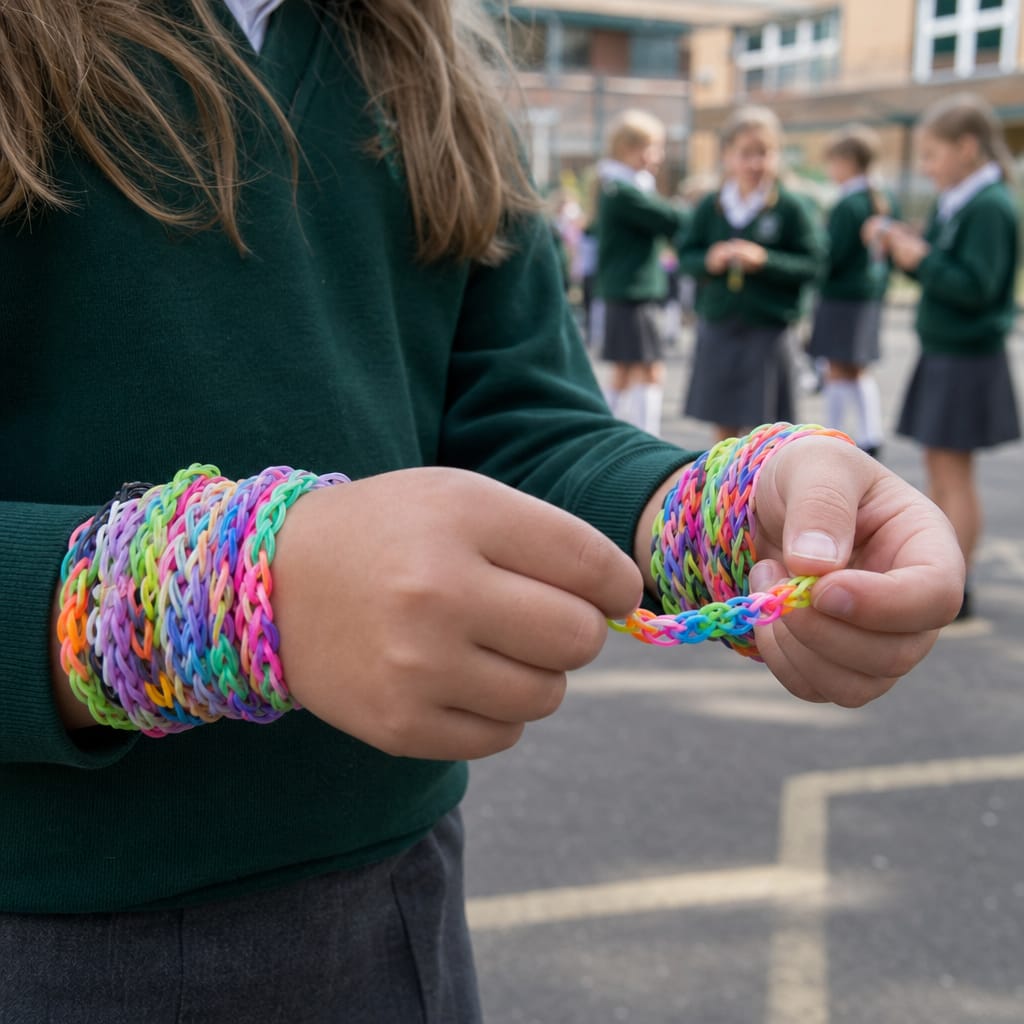
Adult trends move from the top downwards. A designer shows something on a catwalk, a celebrity is photographed in it, and then an algorithm pushes it into a feed three thousand times until it feels like something everybody has already decided. By the time you buy those trainers, the aspiration has already been baked in. You are not just buying the object – you are buying the sense that this is what a person with good taste currently does.
Children cannot do any of this. They do not have designers or celebrities or algorithms with access to their demographic. What they have is each other, in a small outdoor space, for forty minutes a day. So trends among children spread entirely sideways, from one child to the next, at the speed of word of mouth and the speed of wanting very badly not to be left out. This is called social contagion, and in playgrounds it operates at almost laboratory purity.
What's Being Synchronised
Here is the genuinely interesting thing. Whether it is loom bands or a particular phrase or a clapping game that nobody can remember learning, the thing being spread is rarely the object or the game itself. The object is almost incidental.
What is being transmitted is a signal. Something that says: I am inside this group, and if you know about this too, then you are also inside this group. The trend is the handshake.
This is why playground crazes extinguish so completely and so fast. The moment every child has loom bands – including the ones on the outside of every social group – the handshake stops working. It no longer tells you anything about who is in and who is out. So it dies, not because anyone decided it was over, but because it has done its job and cannot do it any more.
The Bit Adults Won't Like
Once you see that mechanism in a playground, you cannot entirely unsee it in adult life. And that is a slightly uncomfortable afternoon.
The trainers that half of one particular street is wearing, the phrase that suddenly everyone you know has started using, the houseplant that appeared in every flat at the same moment in 2019 – all of these follow the same basic logic. The aspiration and the taste and the celebrity endorsement are real, but underneath them, the signal being sent is identical. I am still inside the group. We are still synchronised. This is what being current looks like right now.
Adults tend to prefer the top-down story because it flatters the decision: I saw this, I responded to quality and good design, I chose it. Children cannot tell themselves that story because there is no top in their system at all. So they are left with the honest version. Which makes them, slightly unexpectedly, the more reliable observers.
The Fastest Trend You've Ever Seen
A craze can sweep an entire primary school in under a week and be completely dead within a term. That is not a failure of children's taste. That is a trend doing what trends do, but without any of the scaffolding that usually slows the process down in adult culture – the advertising cycle, the seasonal collection, the gradual trickle from expensive to affordable.
Strip all of that away and you get the playground. Forty kids, forty minutes, and a small rubber toy that means absolutely everything on Tuesday and absolutely nothing by half-term. The sociologists have a lot of words for what happens there. The eight-year-olds are just getting on with it.
FAQ
Why do playground crazes disappear so quickly?
Playground crazes, like loom bands, become extinct quickly. The trend of every child having loom bands, including those who are outside of all social groups, ceases to function as a signal to others. No one “decides” to stop a playground craze – it simply has done its job and can’t do it any more.
How are playground trends different from adult trends?
Unlike adult trends that travel from a designer to a celebrity to an algorithm, playground crazes are spread horizontally from child to child in a playground for forty minutes a day, by word of mouth and fear of being left out. Once every child in a playground has loom bands, including those outside of every social group, the trend has done its job and can no longer signal inclusion to other children.
What is actually being spread in a playground craze?
A trend spreads by signal, not by object or game. The signal is a marker that tells you that I am part of a group, and if you too know of this trend, you are part of it as well. Whether it is a loom band, a phrase or a clapping game is almost irrelevant. The trend functions as a handshake between children.
How long does a playground craze last?
A whole primary school can be swept by a craze in under a week, only for it to be completely dead within a term. That pace is not a failure of children’s taste; it is in itself a hallmark of trends working outside the normal cycles of advertising, of seasonal stock, and of expensive items gradually becoming affordable that slow adult trends down.