
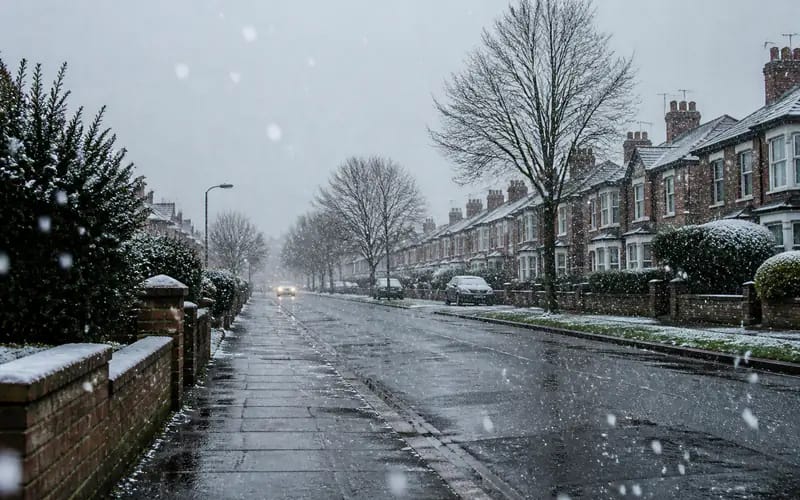
A common myth is that it has to be sub-zero for air of ground level for snow to fall. However, this is not the case. In fact, snow falls perfectly well when the air at ground level is several degrees above freezing. What matters is the temperature at which the snow falls: the temperature in the cloud above you.
The Freezing Point Myth
The common notion that air must be sub-zero at ground level before it can start to fall as snow is another persistent weather myth in the UK. In fact, the vast majority of snow falls whilst the air is above freezing. All that is needed is for the air to be cold enough high up in cloud for the water vapour to freeze directly into ice crystals and for the temperature to drop sufficiently as the crystals fall through a thin layer of warm air below before they start to melt.
Why Cloud Temperature Matters More Than Ground Temperature
Snow forms in clouds below freezing and falls to the ground as snow where the air below is also cold enough. It can fall and settle in place when the temperature is below around 2°C but can also fall and melt on contact with the ground when above this temperature, sometimes heavily. In such cases the falling snow can cool the air around it to below freezing temperature, leading to sudden snowfall even when the temperature is above 3°C or 4°C.
The 2°C Cut-Off, And Its Limits
Many forecasters in the UK use 2°C as a rough cut-off for the chance of snow. Below this temperature, there is a reasonable chance of snow falling and settling. But above 2°C, the falling snow will generally start to melt on its way down through the air, resulting in rain rather than snow. However, heavy falls of snow or a sudden cold blast can bring snow down even when temperatures are above 3°C or 4°C. This is because falling snow will start to melt and cool the air around it as it does so.
What Sleet Actually Is
Sleet is not a ‘mistake’ by the weather forecasters, nor is it a halfway house between snow and rain. In fact sleet is a separate type of weather, which is made up of partially melted snowflakes. These have not fully turned into raindrops yet, but the flakes have started to melt on the edges as they fall through the air. Typically sleet forms when the air temperature near the ground is close to the freezing point, i.e. it is cold enough for snow to fall from higher up in the cloud but then melts on the way down to form sleet. The flakes are still intact but start to get wet and heavy.
Why Very Cold Air Doesn’t Stop Snow
While many people believe that it can get too cold to snow in the UK, in reality very cold air holds very little moisture and thus in very cold spells we tend to get light, dry, powdery snow rather than lots of wet, heavy flakes. While the amount and type of snowfall may vary in very cold weather, the fact remains that snow will continue to fall as long as there is cold enough air in the atmosphere for it to form in the first place.
Ground And Road Temperature Decide Whether It Settles
Falling and settling are two different things. Grass, car roofs, fields, etc. tend to cool quickly to a temperature near to that of the air. As a result, they tend to get snow covered quickly. Roads, pavements and cycle tracks on the other hand tend to retain the heat from the ground below them as well as from traffic moving across them. As a result, they tend to remain snow free for a long time, even when the surrounding area is snow covered. This is why councils use ground temperature to decide whether to grit or not and this is how you clear snow from roads, paths and cycle tracks. Surface temperature, not air temperature, is what matters when it comes to melting already fallen snow.
How Many Days Snow Lies
UK average over 1991 to 2020 = 13 days a year on which snow lies; for Scotland = 23 days a year on which snow lies. This is because most of the time the fallen snow will either melt on contact with surfaces that are warmer than the falling snow or it will fall in such small amounts that it will melt or disappear within hours.
Snow, Sleet And Settling At A Glance
Snow forms at temperatures below freezing high up in clouds and then falls to the ground where it will melt on contact with warmer surfaces such as roads and pavements. Sleet forms in a similar way but falls through a warmer layer near the ground which causes the falling snowflakes to melt on their way down. Sleet is made up of partially melted snowflakes and can accumulate on surfaces such as grass and rooftops but will melt on roads and pavements and churn up into slushy snow on busy traffic areas.
Common Mistakes
The myth that it can be “too cold to snow” in the UK. In reality, very cold air simply means that the resulting snow is more powdery and drier than in milder weather, and falls in lighter layers.
Don’t expect snow to fall on roads and pavements as quickly as it does on grassy areas. The temperature of the ground and the amount of traffic flowing across roads and pavements will mean that they take longer to freeze over and, once they have, the snow will melt quickly.
Sleet is not a failure to forecast snow. Sleet is a form of precipitation that consists of partially melted snowflakes.
The number of days with snow falling can differ significantly from the number of days with snow lying. Both are generally published for the UK as a whole for the winter months and for a specific year.