
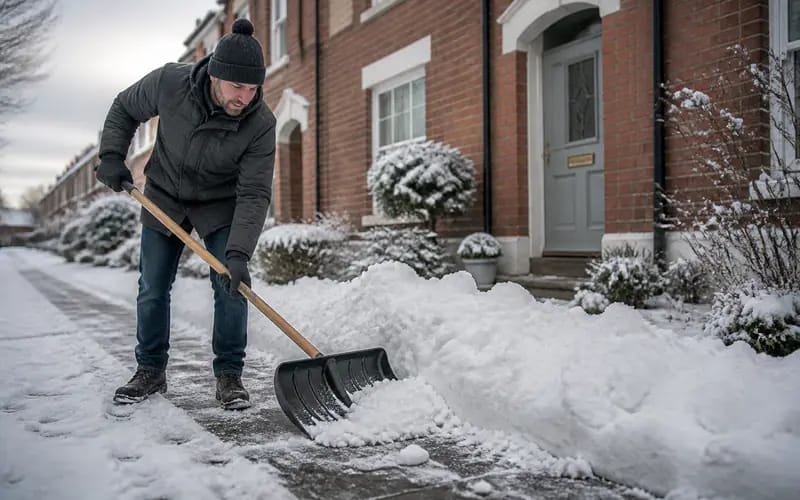
Clearing snow from your path can be a scary business – someone is bound to slip up and sue you for every scrape and bruise. So it’s encouraging to find out that in most cases, you’ll be fine to clear your path without worrying about getting sued for carelessness. Here’s the real guidance on clearing snow and what to do in order to avoid accidents.
The myth and where it comes from
The idea that by clearing snow you become liable for any accidents that happen as a result is a long-standing myth. It’s often repeated as some kind of ‘fact’ and it makes sense at first – if no one cleared the snow then no one would be liable for any accidents that happened on it. However, this isn’t how the law treats the issue of clearing snow and ice from paths and pavement.
What gov.uk actually says
It is worth reading the government’s official guidance on clearing snow from a path on the Gov.uk website. In summary, you’re unlikely to be sued or held responsible for injuries on paths and pavements you have cleared of snow and ice as long as you have acted sensibly and carefully. The guidance suggests that clearing snow and ice from the path outside your home is a sensible and neighborly thing to do with no legal liability attached.
Why a claim rarely succeeds
To claim against someone who has cleared a path of snow and ice, a person would need to show that the person who had cleared the path had been careless or even reckless in how they had cleared it. The courts understand that in winter, snow and ice are a problem for everyone, and no one can make a path completely safe. In general, liability for accidents on paths and other public places is based on the concept of carelessness, not on the fact that an accident has occurred. Thus, as long as you have taken a reasonable and careful approach to clearing the path, you are unlikely to be held liable for any accidents that may occur.
Use salt or ash, not hot water
Hot water will clear the snow fast but within a few hours the melt water will have refrozen to a thin layer of very black very smooth ice – worse than the original snow. In contrast, salt, grit, sand or even ash from a woodburner lowers the freezing point of any moisture in contact with the surface and prevents it from refreezing overnight. Best to spread this out thinly and evenly over the cleared snow rather than trying to clear the lot first.
Why grit bin salt is off limits
Many towns and cities have ‘Grit Bins’ that are filled with salt for use on roads, but these are usually specifically designated by the council for certain sections of road that have been identified as needing to be treated. Removal of grit from these for use on private driveways could therefore leave crucial sections of road and path that the council have identified as needing to be treated without sufficient supplies to deal with. Some councils even specifically ask residents not to use salt from these bins on private property and the rules are often outlined in the council’s community safety policy or wider council guidance. If you do need to buy salt then rock salt is usually found in most hardware stores and supermarkets and costs very little.
Clear a path down the middle first
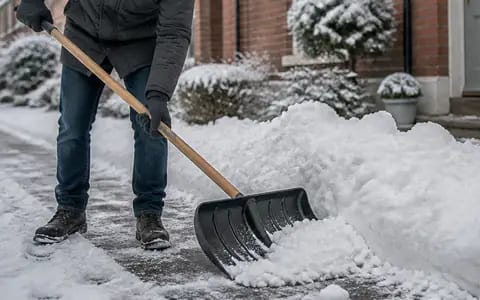
Rather clear a path of about a single shovel width down the middle and then widen it from both sides. The cleared snow should be piled up on the edges of the path rather than in the middle of doors or gates where it will be trodden straight back onto the path. Clearing a single path down the middle allows people to pass safely in both directions while you complete clearing the rest of the path.
Steps and slopes come first
Before you know it, you will be jumping to clear the easy bit, i.e. the broad flat bit of path. Don’t. Steps, Ramps and Slopes need treating first. This is because they present the biggest single risk of a fall. Uneven surfaces plus gravity are a deadly combination. Clear and treat these areas before you start on the broad flat surfaces. Later in the day re-check these areas as melt water will have re-frozen and turned into a sheet of black ice.
A simple safe-clearing checklist
Clearing the snow and ice from your path can be a simple job, it just needs to be done in the right order: clear the bulk of the snow from the centre path first and then widen it outwards from there, clear steps and slopes first and then treat the remaining flat surfaces. Spread salt, ash or other grits thinly over the cleared surface and not before you have cleared the snow. Avoid using hot water to clear the snow as this will form into black ice very quickly and is very hazardous. Avoid using salt from the orange tubs as they are for treating council identified danger points and you will be taking it from where it is needed to keep other roads and paths safe. Clearing the snow from your path does not have to cost the earth and is a simple task that can be completed with a simple shovel, some salt or sand and a little patience.
Common mistakes to avoid
It is usually better to use salt or ash (such as from a wood burner) as these do not melt snow which will then re freeze to form a very slippery surface of black ice. Hot water is very bad as it will melt the snow and then re freeze to form a very slippery surface of black ice overnight. Salt from a grit bin is for treating roads and junctions that the council has identified as needing to be treated in adverse weather. Even if you put the salt in the grit bin it is usually requested that you do not use it for personal use on paths and drives. In addition to these reasons, using council supplied salt for personal use leaves less for where it is actually needed. Rock salt is very cheap from most hardware stores and supermarkets. In terms of clearing paths, the main thing is to clear a path down the middle of the pavement first to allow immediate access. Then clear outwards from both sides. Clear the steps and slopes first as these are the most hazardous areas and are where people are most likely to fall. Then clear the remainder of the path in the same way as described above. It is much easier to clear a narrow path first and then widen it out from there, rather than trying to clear the whole width of the path first. Also, pile the snow up to the side of the path, rather than in the middle. This will stop people walking over the cleared area and re-tracking it straight away.