
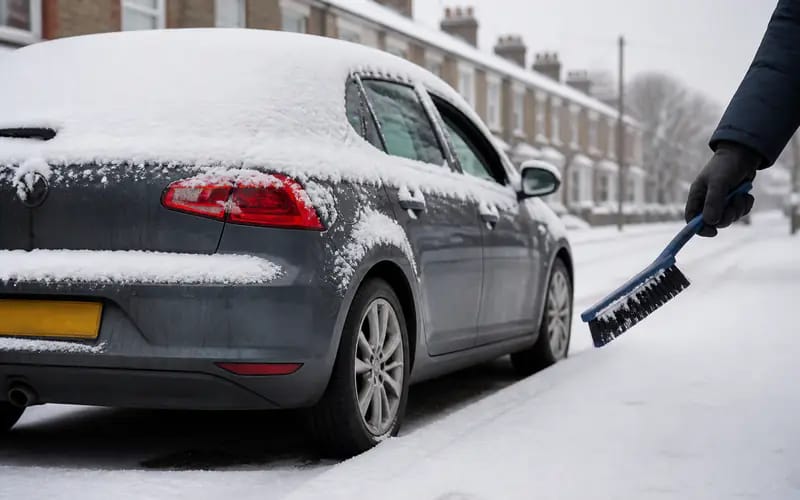
Driving around with snow on your car’s roof is not a specific offence but can cause serious problems on the road. In line with Highway Code Rule 229, before driving off in snowy weather you must make sure that all of your car’s windows, lights and number plates are completely clear of snow and ice. If the snow on your car’s roof falls off whilst driving and blocks your own or another car’s windscreen, you could be prosecuted for careless or inconsiderate driving. In this article we explain what Rule 229 actually says, why it’s so important and how you can clear your car of snow in just a few minutes.
What Rule 229 Actually Says
These are all the winter driving points covered by Highway Code Rule 229. Note that the wording of Rule 229 is quite specific and the rule tells you what you must do in order to be able to see to drive before you set off. So, there is mention of the need to clear snow and ice from all windows but there is also a requirement in respect of lights and number plates. The word ‘must’ is used throughout Highway Code in order to clearly indicate a legal requirement and in the case of the wording of Rule 229 above, this means that there is a specific law to back up each point.
The Real Legal Hook
This is not the full offence of ‘Driving with Snow on Roof’ as such but the more serious offence of ‘Driving a Vehicle in a Defective Condition’ which could result in prosecution under Road Vehicles (Construction and Use) Regulations 1986, regulation 30. This regulation outlines the driver’s view to the front and sides of a vehicle and the general condition of the vehicle. As mentioned previously, if snow, ice or even condensation can impede a driver’s view of the road ahead, or if a vehicle’s lights or number plates cannot be seen from a reasonable distance, then the vehicle is considered to be in a defective condition and the driver could be prosecuted for driving such a vehicle on the road.
Why Roof Snow Specifically Is Dangerous
A roof loaded with snow may look fine but it rarely stays in place. When you brake sharply or set off quickly, great slabs of snow can slide down and block your view. And when you’re travelling along slowly, snow can fall off your roof and slam into your rear screen or that of the car behind you. This is a major hazard for other road users and can cause serious accidents. As the leading authority on road safety and accident prevention, RoSPA cites obscured vision from snow and ice as one of the main causes of accidents during the winter months.
How This Gets Prosecuted In Practice
There is no specific fixed penalty offence of ‘driving with snow on roof of car’. However, as previously mentioned if a driver’s view is obscured by snow and he or she is involved in a collision, or is spotted by Police driving around with an almost cleared windscreen, he or she could be charged with careless driving, or driving without due care and attention, or even driving a vehicle in a dangerous condition. The same driving offences are used against drivers whose vehicles are not roadworthy, and the fact that it has been caused by snow does not make it any less of an offence or any less serious.
The Five-Minute Clear-Down Routine
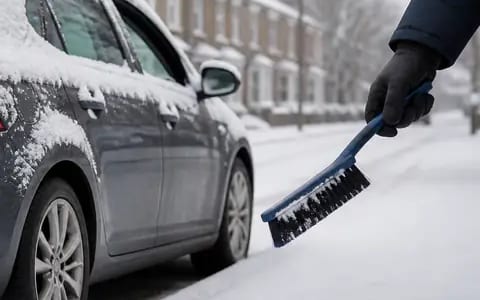
Of course there is an order to clearing the car. First clear the roof and bonnet of the car. Then clear all of the glass of the car. This means clearing the full area of the windscreen and not just a letterbox size piece of it. Then wipe all of the lights of the car including the headlights, rear lights and number plates on the front and back of the car. Finally, clear any snow from the mirrors and give the car a few minutes to demist before setting off. More detail on tips on preparing your car for snow is set out in the published guidance.
Common Mistakes People Make
The biggest error is clearing a letterbox size area of the windscreen to drive off and not clearing the side windows, rear of the car, mirrors, lights etc. In many cases all of these areas will have accumulated thick amounts of caked up snow and ice during the day and will be difficult to clear in cold weather. It’s very easy to clear just the middle of the windscreen and drive off, but this is how accidents occur, especially when there is caked up snow and ice covering up the headlights, tail lights and number plates of the car.
What To Keep In The Car
Having the right gear in the car means you can clear your car in a matter of minutes, rather than wasting twenty minutes or more to clear it. A good ice scraper, a decent bottle of de-icer and a soft brush for the roof and bonnet of your car are the main items you’ll need. The RAC also suggests that you keep a torch and a blanket in the car throughout the winter in case you get caught out on a cold day and have to travel slowly.
Quick Final Check Before You Drive
– Clear every window fully, not just a porthole
– Clean lights and number plates front and back
– Brush the snow from the roof and bonnet of your car to stop it falling onto your windscreen or the back of the car in front. – Demist fully before moving off – Pack a scraper, de-icer, torch and blanket in the car
A Couple of Quick Questions
No, but driving with an obscured view, dirty lights or plates that cannot be read is an offence and roof snow is a common cause of all of these problems when driving after clearing the snow from your car.
Is falling snow a problem for me? No, providing you have cleared it before driving, however if it falls off whilst you are driving and causes an accident or a near miss you could be charged with careless or inconsiderate driving.
Clearing your car before you set off will take around 5 minutes and be worth it. Neglecting to clear your car properly could result in more problems than just being late!