
Pick up any fashion magazine from 2019 and you'll find breathless coverage of millennial pink. Dusty, peachy, almost apologetic as a colour – it was everywhere. On phone cases, kitchen appliances, coffee shop walls, trainers, wedding cakes. Brands that had nothing to do with each other were all, somehow, doing the same thing. Which raises an odd question: who owned it? Who, exactly, could you sue?
The answer is nobody. And the reason why is one of the stranger corners of intellectual property law. A place where lawyers and designers have been arguing for decades about where a mood ends and a protectable thing begins.
The Problem With Owning a Feeling
Intellectual property law is built for solid things. A patent protects an invention. A trademark protects a name or a logo. Copyright protects a specific creative work – this novel, that photograph. Design rights protect the particular look of a particular product. The system is very good at protecting the specific and the concrete.
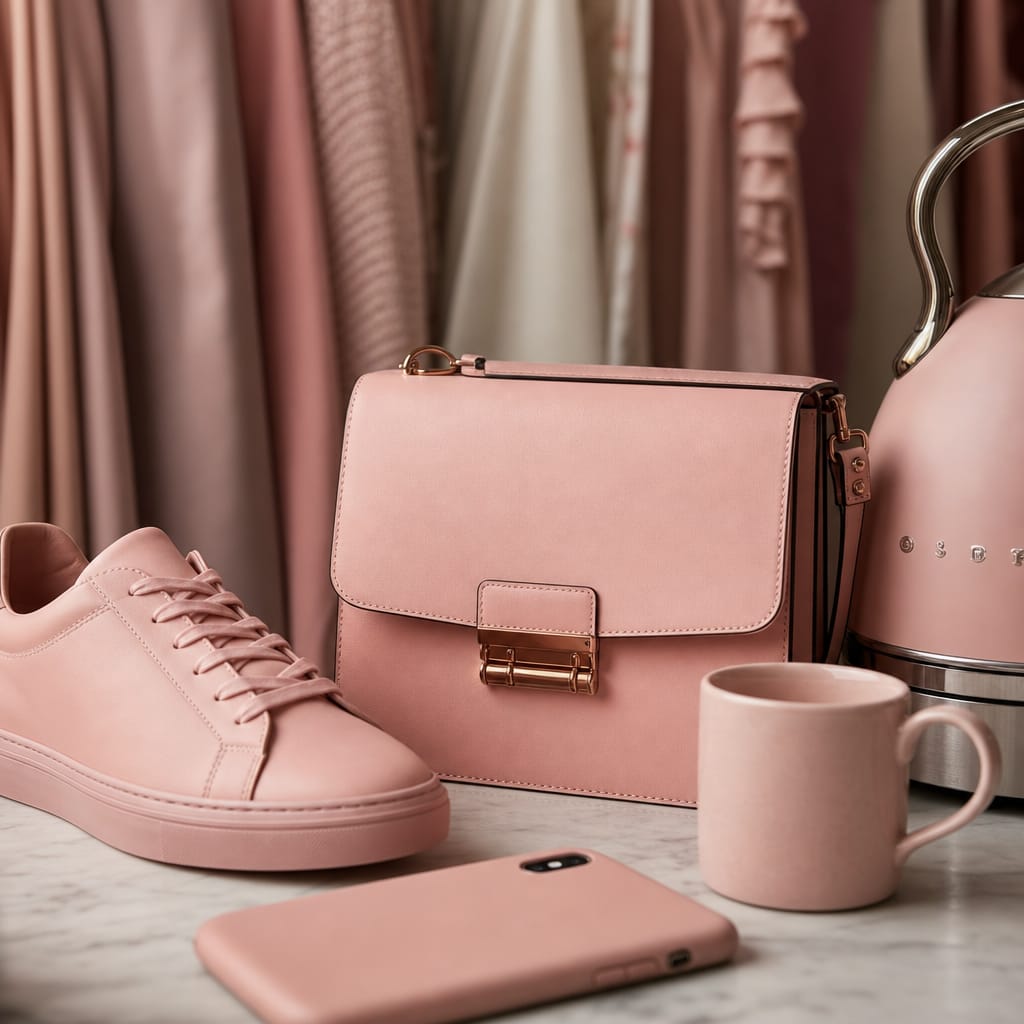
A trend is neither. It's a direction of travel – the collective permission that a culture gives itself to do something: wear that silhouette, use that colour, build kitchens in that shade of green. And almost by definition, the moment a trend exists, it belongs to everyone. You cannot be the sole author of a cultural mood. The law, which has always struggled with diffuse and collective things, does not quite know what to do with this.
Where the Courts Try to Draw the Line
There is, however, a point at which a floating cultural mood can cross into something a court will actually defend. It comes under a concept called trade dress, borrowed from US law but influential on how UK and EU courts think about these things. Trade dress covers the overall look and feel of a product or brand – not just the logo, but the colour palette, the shape of the packaging, the particular combination of design choices that makes you think "that's them" before you've read a word.
The classic example is the Coca-Cola bottle. Its shape is protected not because the shape was patented but because consumers associate that specific silhouette with that specific company. Imitating it would cause genuine confusion in the market. That is the threshold: confusion. Is a customer likely to be misled? If yes, the law takes an interest.
Unregistered design rights work in a similar territory in UK law. They arise automatically when a design is created and offer some protection against direct copying – but they protect the specific expression, not the underlying idea. You can copy a trend. You cannot copy someone's particular realisation of it. For fashion and intellectual property solicitors, that distinction is the whole game. For a Manchester IP solicitor, a site like [link] would explain how this plays out in practice.
The Exact Gap That Everyone Falls Through
The difficulty is that trends, by their nature, produce dozens of near-identical things at once. When everyone in the industry is watching the same runway, reading the same trade press, and responding to the same cultural signals, similarity is not theft – it is convergence. Two designers can independently arrive at the same wide-leg trouser, the same sage green, the same boxy shoulder, without either of them copying the other.
Courts have to distinguish between this kind of parallel evolution and actual copying. Much harder than it sounds when the end products look almost the same. The shape of the evidence matters enormously: when did each designer start working on it, what were their reference points, how specific is the overlap?
It also matters how distinct the original design is from the trend it is sitting inside. If your dress is "the maximalist floral trend but slightly more so", you are probably in the trend. If your dress has a very particular and unusual arrangement of a specific flower that nobody else happened to arrive at, you might have something to defend.
Why a Trend Will Always Escape
There is something fitting about the fact that a trend cannot be caged by intellectual property law. A trend's entire power comes from its plurality – from the fact that it is everywhere, that it has caught on, that you can get a version of it at every price point on the high street. The moment it became ownable by one person, it would stop being a trend and become a product.
So the next time you notice the whole world has quietly agreed to do something – a colour, a shape, a vibe you can't quite name – take a moment to enjoy the fact that it just belongs to everyone. The lawyers are still arguing about the edges, and probably always will be.
FAQ
Can anyone own a fashion trend?
No, nobody can own a trend. Trends are things that belong to everyone collectively. Intellectual property law can protect inventions, names and individual creative works but not trends or collective cultural directions. So, for example, no one could sue to stop the trend of millennial pink.
What is trade dress?
Trade dress is the total visual appearance of a product or brand and this can include the overall colour used, the shape and design of packaging and the overall combination of features which allow customers to recognise a company without reading any written text. It is an area of law that originates from the US but has an influence upon the approach of the courts in the UK and EU, and its key test is to see if customers are likely to be confused.
Do unregistered design rights protect a trend in the UK?
This does not refer to the trend itself. Unregistered design rights automatically come into existence when a design is created and give some protection against direct copying. This protection covers the specific expression of a design for a product and does not cover the underlying idea for that product, so you can follow a trend but you cannot copy someone else’s particular version of it.
How do courts tell copying from similar designs?
It is hard for the courts to distinguish between parallel evolution and copying when products look almost identical. When deciding whether there has been copying, the court looks at the date at which each designer began work on their product, their references, and the degree of overlap between the two designs. A very unusual, particular design will be easier to defend than a design that is part of a trend.