
There is a rule buried inside the physics of heat loss that nobody tells you when you're standing in B&Q weighing up rolls of loft insulation. It goes roughly like this: the first layer does most of the work. The second layer does quite a lot. By the time you're adding a fifth layer you're essentially just making a very expensive mattress for your attic floor.
This isn't intuition. Intuition says that if 100mm of insulation keeps in X amount of heat, then 200mm keeps in twice as much. Neat, satisfying, completely wrong. The actual relationship is logarithmic, which sounds like something your maths teacher said to punish you, but what it really means is this: each extra layer you add saves less energy than the one before it. The first 50mm of loft insulation you lay down will save more heat than the next 250mm combined. That is not a typo.
Why Your Loft Floor Is the Most Powerful Thing in Your House
Hot air rises, obviously. Your house is essentially a slow and very expensive leaking balloon, and the biggest hole at the top is your ceiling. An uninsulated loft loses heat at an extraordinary rate. Put in that first layer of mineral wool – even a thin one – and you have broken the direct connection between your warm ceiling and the freezing air above it. The physics is doing heavy lifting here. You've gone from a single bad barrier to two layers of resistance, and that jump, from zero to something, is always the biggest gain you will ever get.
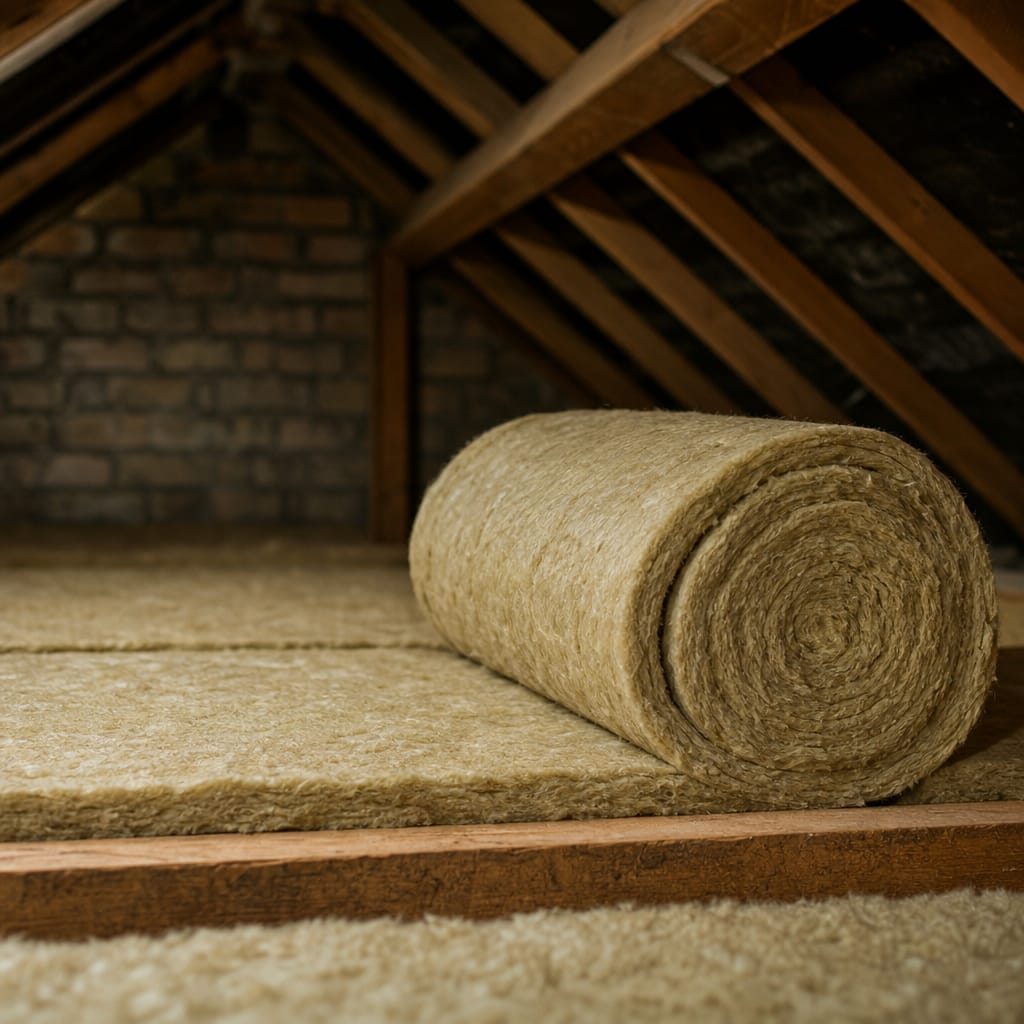
Roll in another 100mm on top and you improve things further, yes. But you have already captured the dramatic part of the curve. By the time you're debating whether to go to 270mm versus 300mm, you are in the land of diminishing returns so flat it barely registers on a graph. The recommended depth for UK loft insulation is 270mm, which is the right answer – but the last 150mm of that is not doing anything like what the first 100mm did.
The Gap Under Your Door Is Lying About Its Size
This is where the logarithmic logic flips into something useful and slightly annoying. Because here's the counterpart to "more insulation does less and less": a small gap or a thin wall does far more damage than it looks. The heat loss through a surface is roughly proportional to the temperature difference across it and inversely proportional to the resistance in the way. Strip out all the algebra and what remains is this: a 5mm gap under a front door, sitting there with nothing but cold January air rushing through, is working against you harder than a badly insulated wall section many times its size.
People spend thousands on cavity wall insulation while the draught excluder they bought in 2019 is sitting in a carrier bag in the under-stairs cupboard. That gap is thin, but it has zero resistance – and zero resistance means heat is escaping with absolutely nothing to slow it down. Fix the gap and you're buying the cheap, dramatic end of the curve. Leave it and keep layering insulation on walls that already have some, and you're at the expensive, flat end.
The Boiler Upgrade That Disappoints You
The same logic is why people feel mildly cheated after upgrading their boiler. A new, efficient combi boiler is a genuinely good thing – modern condensing boilers run at around 90% efficiency or higher, versus perhaps 70-75% for an old non-condensing unit. That sounds like a big jump, and it is. But if your house is still losing heat quickly through thin walls, single glazing and that gap under the door, the new boiler is working harder to compensate for all of it. You've upgraded the tap, not fixed the leaking bucket.
The physics rewards you most when you attack the worst problem first. Always. The most draughty, uninsulated, thermally hopeless part of your home holds more savings than any appliance swap, because that's where you're still on the steep part of the curve – where a small improvement has a large effect.
The Right Order to Do Everything
So if you're working through a heating overhaul and wondering where to start: seal the gaps first. That's cheap and dramatic. Insulate the loft early – you're still very much on the good part of the curve. Sort the walls, then think about glazing, and only then ask whether the boiler needs replacing. That order is not arbitrary. It's just the mathematics telling you where the magic still lives.
FAQ
How thick should loft insulation be in the UK?
The recommended depth for UK loft insulation is 270mm. While the benefit of a thicker layer of insulation does continue after the first 100mm or so of the layer, the returns are so flat after this that the difference between a 270mm layer and a 300mm layer is hardly worth considering.
Does doubling loft insulation double the heat saved?
No, doubling the thickness of the material does not double the savings. The saving goes down logarithmically with each additional layer. The first 50mm of loft insulation saves more heat than the next 250mm of material combined. This is why 200mm of material does not save twice as much heat as 100mm of material.
What order should I do home heating upgrades in?
Begin with the cheapest measures that will deliver the greatest improvements and work down from there. So, seal the gaps first and then go up into the loft and insulate. Next, tackle the walls and then the windows, and only then consider replacing the boiler.
Will a new boiler cut my bills if my house still loses heat?
Even though modern condensing boilers can have efficiencies of around 90% or higher, compared with perhaps 70-75% for older non-condensing models, a new boiler won’t save as much as expected if your home leaks heat. Thin walls, single-glazed windows and draughts all make for a leaky house, which makes a boiler work harder to heat the same amount of space. So, sort out the worst of these first.