
Televisions were bolted up to the walls of pubs before they sat in our living rooms. They were slightly too small for the back of the room and people craned their necks and nursed their pints. It was the landlord of the pub who had taken the gamble, and it was the regulars of the pub who had the opinion. If it survived Friday night in a Wolverhampton working men's club then it had probably earned the right to exist.
Coincidence it was not. Charming footnote it is not. The pub was the place where new technology went to be judged by ordinary, sceptical people before it was trusted with a place in anyone's home – a kind of public laboratory, funded by mild-and-bitter and entirely ungoverned by anyone with a clipboard.
The Television Did Its Time Behind the Bar
The BBC resumed broadcasting after the war in 1946, but sets were expensive, the picture was small, and nobody was entirely sure television was just a passing novelty. Many people’s first television was in a pub. Crowds gathered to watch them in much the same spirit as people had once gathered around a piano.
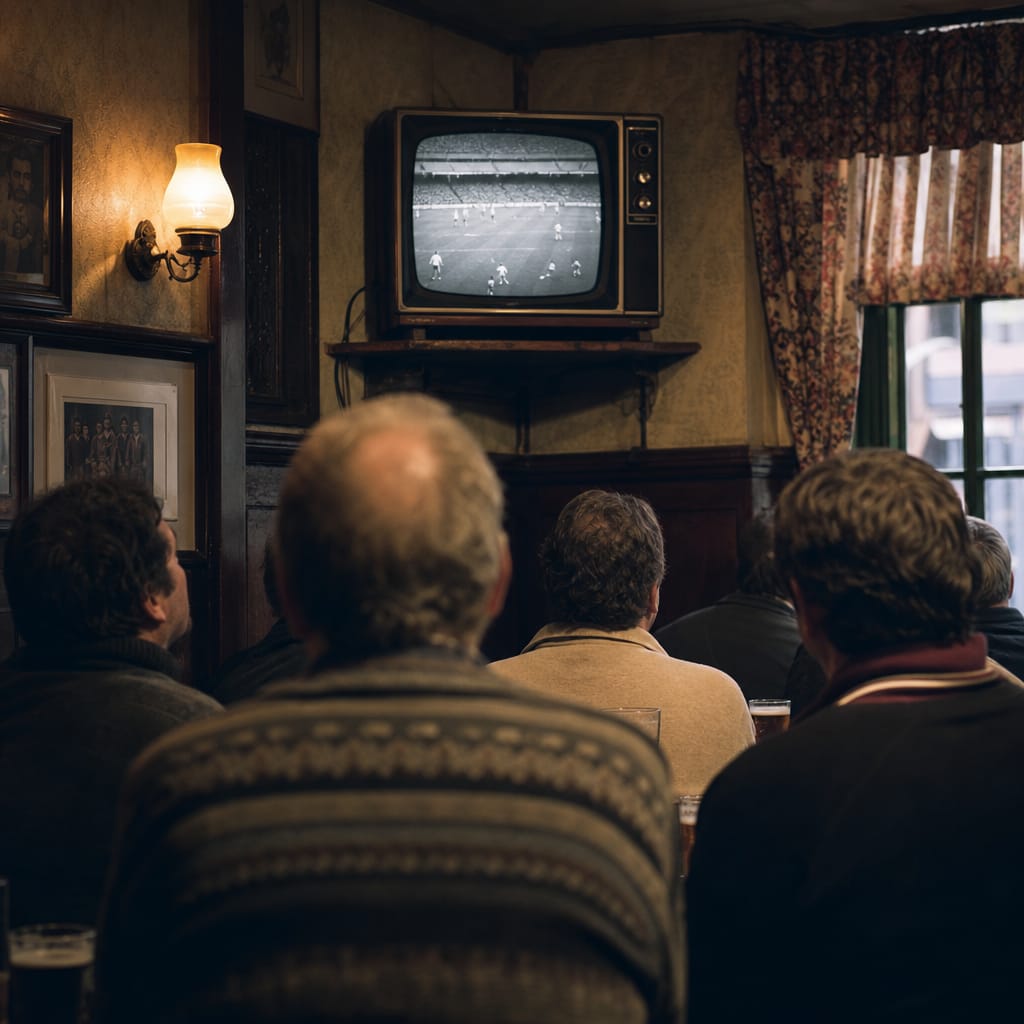
By the time the Coronation was broadcast to an estimated twenty million people in 1953, a large number of those twenty million were in pubs and social clubs, packed shoulder to shoulder around a screen the size of a dinner tray. The living room set came after. The pub had already done the work of normalising the thing.
The Fruit Machine Was Actually the Computer
Going into a British pub in the late 1970s would have been to find a Space Invaders machine near the door or, alongside the pub cigarette machine, a fruit machine with blinking lights and a digital display. These were our first encounters with a microprocessor in action, delivering a visible, interactive experience. Put in some money, press a button, and something would happen on the screen. That is essentially the deal offered by mobile phones, apps and internet banking.
The video game arcade was a distributed computer literacy programme that nobody had planned and nobody was in charge of. The pub version was slightly seedier and focused more on winning 10p back, but was all the more trusted for it. When home computers arrived in the early 1980s, the idea that you could interact with a screen was already familiar, because a whole generation had been doing exactly that since they were old enough to reach the buttons.
The Contactless Future Arrived on a Drip Tray
For most of the twentieth century, cash was the rule in British pubs. But in the late 1980s and through the 1990s, EFTPOS terminals began to appear behind bars. For many people their first cashless transaction was paying for drinks with a card in a pub – not in a supermarket, not in a department store, but at the bar.
The pub made that moment low-stakes enough to try. If the machine failed, you dug out some coins and the bloke behind you ordered. The social cost of a technological failure in the pub was thirty seconds or so of mild embarrassment. That is precisely the right environment for learning to trust something new. And it was in the pubs that the long experiment to pay without cash was largely run. Chip-and-PIN arrived in the mid-2000s, followed by contactless a decade later. The answer, in the end, was yes.
What the Pub Knew
The pub was an effective proving ground because of the crowd’s scepticism. A living room is a private space where you can fail quietly, but a pub is not. If the television picture was terrible, someone said so loudly, and if the card machine broke, it broke in public. This social pressure was the filter, and the technologies that survived it – that kept the room interested, that kept the payment working, that kept the punters coming back – were the ones that had got it right.
This is a slightly strange way to build a technological culture, one pint at a time, under fluorescent lighting with a fruit machine bleeping in the corner. But it did work. The living room got a TV after the pub had vouched for it and, broadly speaking, that's how it's stayed.
FAQ
Why were televisions in pubs before homes?
Television sets were expensive to buy and the picture was small when the BBC resumed broadcasting in 1946. However, many people went to the local pub to watch television as pubs could afford to put a set in. By the time of the 1953 Coronation an estimated twenty million people watched on television with many of them in pubs and social clubs.
How did fruit machines and arcade games help people learn about computers?
In the late 1970s, many pubs offered games like Space Invaders and fruit machines. These gave many people their first contact with a microprocessor, and by pressing a button and putting in money, users could get a reaction from the screen. Home computers in the early 1980s thus felt familiar to many people.
When did people first pay by card in a pub?
EFTPOS terminals started turning up behind the bars of pubs in the late 1980s and 1990s. They provided the first cashless transaction for many people – paying for drinks at the bar. Then came the chip-and-PIN terminals of the mid-2000s, followed by contactless payment about a decade later.
Why was the pub a good place to test new technology?
Pubs are public spaces and therefore any problems that occur are visible to others. Shoddy television pictures were loudly highlighted by someone in the room. So about thirty seconds of mild embarrassment to customers was all that was caused by a broken card machine. Such technology was weeded out by the social pressure in the public space of the pub, and the technology that remained earned a place in people’s homes.