
There is a legal boundary somewhere between your front door and the road (maybe under the path to your front door, maybe under the flowerbed, possibly under the bit where next door’s cat keeps digging). Most homeowners will go their entire lives without knowing it exists, and it does not appear on your deeds. It was not mentioned at the conveyancing stage but the moment something goes wrong with your water supply, this invisible threshold becomes the most important line on your property.
Welcome to the world of the communication pipe. Or rather, welcome to the bit of it you almost certainly don't understand. Neither did most solicitors until relatively recently. We're being honest here.
Your Water, Their Pipe
The water is yours the moment it crosses into your property. The pipe it arrived through? That's a whole different question, and depends on exactly where that pipe is buried.
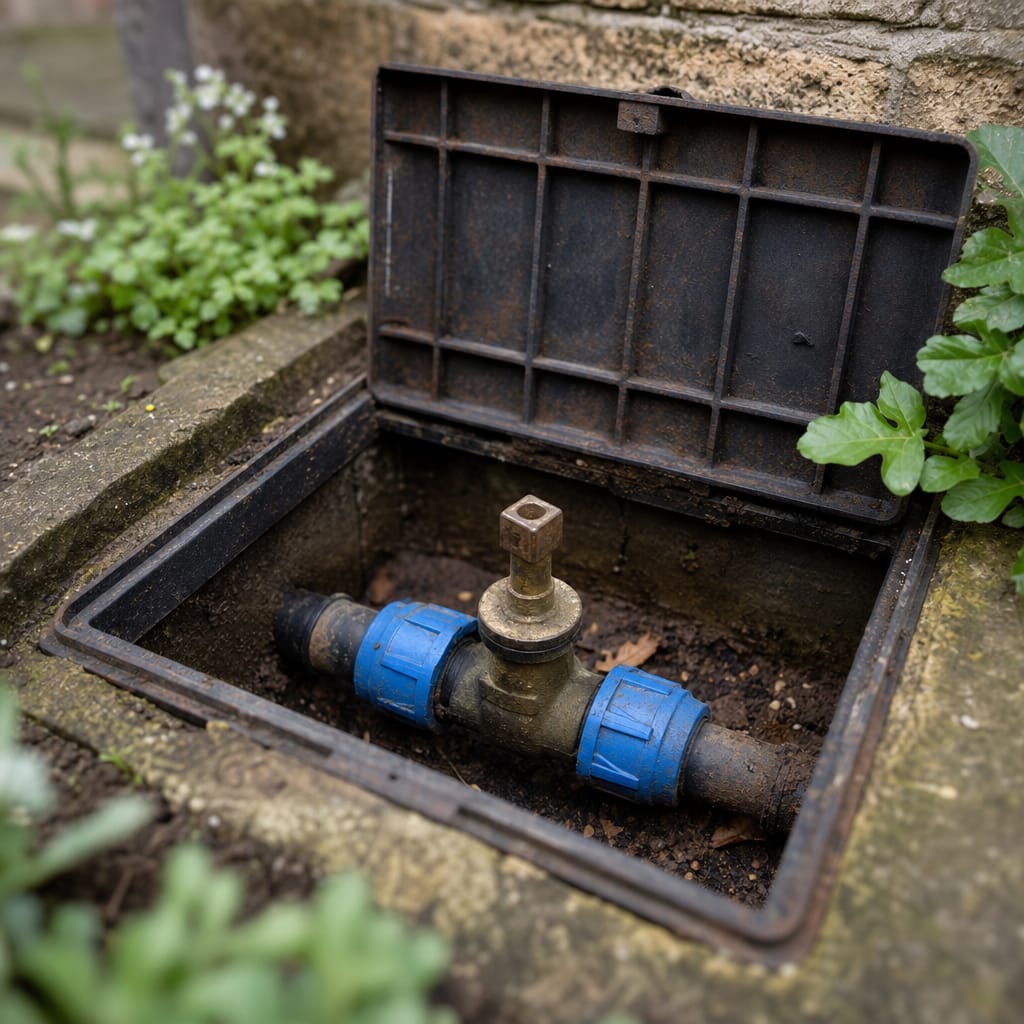
Water companies in England and Wales own what's called the communication pipe: the section of pipework that runs from the main in the road up to your external stop tap, usually found in a stop tap chamber near the boundary of your property, such as under the pavement or inside the garden wall. That stop tap has a square fitting and needs a stopcock key to turn it. All of the pipework on the company's side of that stop tap belongs to your water company, not to you, and if it splits, collapses or leaks, it is their problem and their bill.
The pipe from the external stop tap to the internal stop tap under your kitchen sink is called the supply pipe. This pipe crosses your garden, burrows under your drive, threads through the wall of your house and is your responsibility and your cost.
The Stopcock You Reach for in a Flood
This is where things get genuinely strange. Most people's instinct in a water emergency – a burst pipe, a gushing joint, the kind of thing that has you running down the stairs in your socks at midnight – is to find the internal stopcock first. Sensible enough. But the actual cutoff point is the external stop tap near the boundary. This is owned by your water company. You are legally permitted to use this in an emergency even though it sits on their infrastructure, using a long-handled stopcock key which costs a few pounds, but is worth keeping in a cupboard. The external stop tap itself remains theirs.
Before the Water Industry Act 1991 was clarified and updated over the years, it was even more confusing. The line between company-owned and homeowner-owned infrastructure was murkier. Homeowners had sometimes been held responsible for sections of pipe running far further towards – and even under – the road than they should have been. On the drainage side, the 2011 transfer of responsibility for private sewers was a big moment: millions of homeowners quietly stopped being liable for shared sewer sections overnight when those transferred to the water companies. Many still do not know it happened.
The Pipe Under the Road That Might Still Be Yours
One of the more awkward scenarios is where your property shares a supply pipe with neighbouring properties – common in older terraced streets where a single pipe was laid to serve several houses and then branched off. Such an arrangement is called a 'shared supply'. The pipe between the road and the point it splits is sometimes maintained collectively by the homeowners sharing it, and you could theoretically be partly responsible for a pipe that runs under the public road.
Sometimes a water company will adopt these shared supply pipes voluntarily where they present ongoing problems but there is no obligation for them to do so. If your property is a Victorian or Edwardian terrace it is worth checking with your water company whether your property is on a shared supply. The water company’s website should have a map of the network and they can often tell you over the phone.
It’s not common knowledge. The plumber who comes to fix a leak will know. The water company’s technical team will know. But the person standing in their own kitchen watching water bubble up through the floor will almost certainly not know. And that seems a strange gap given that the answer to ‘whose problem is this?’ can mean the difference between a free repair and a four-figure bill.
FAQ
Who is responsible for the communication pipe?
The water company owns the communication pipe in England and Wales. It runs from the main in the road to your external stop tap, usually in a chamber near the boundary, such as under the pavement or inside the garden wall. If this section splits, collapses or leaks, the repair and the bill are the company’s.
Who pays for the supply pipe to my house?
You are responsible for the supply pipe, and you pay for any repair. It runs from the external stop tap to the internal stop tap under your kitchen sink, crossing your garden, going under your drive and passing through the wall of your house. Everything on the water company’s side of the external stop tap is theirs.
Can I use the external stop tap in an emergency?
Yes, you are legally permitted to use the external stop tap in an emergency, even though your water company owns it. It has a square fitting, so you need a long-handled stopcock key, which costs a few pounds. It is worth keeping one in a cupboard, but the tap itself remains the company’s.
How do I find out if I have a shared supply pipe?
Contact your water company, especially if you live in a Victorian or Edwardian terrace. Its website should have a network map, and staff can often tell you over the phone. A shared supply serves several properties, and you could be partly responsible for the shared pipe, even where it runs under the public road.