
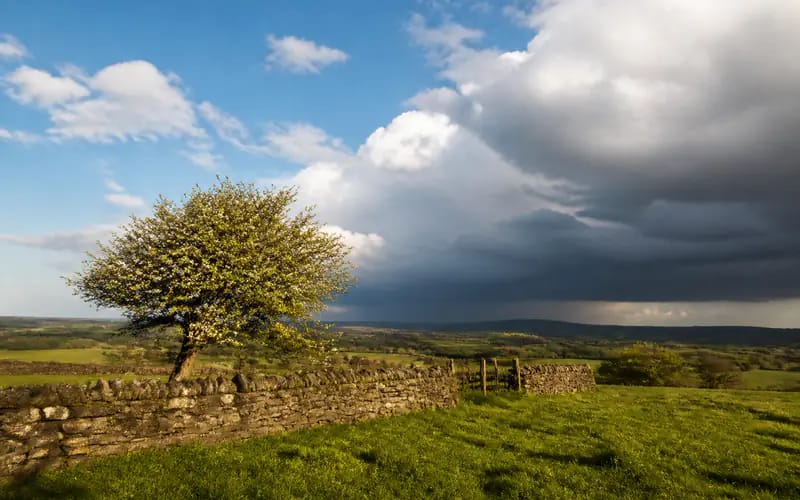
In April it often turns chilly again later in the day and hail forms in a shower cloud when ground that has been warmed by the sun in the hours before in contact with cold air above. The resulting cloud produces hailstones instead of rain.
Why Spring Air Is Especially Unstable
Spring air is particularly unstable, since by April the sun can warm the ground within an hour or two of cloud clearing to create a layer of warm air near the surface. However, above this there will still be an air mass left over from winter which is cold and sluggish. Thus when the warm air from near the surface tries to rise through this cold air above, it does so very forcefully since there is a large temperature difference between the two layers. This is the sort of atmosphere that meteorologists describe as unstable and it is just this sort of atmosphere that spring produces more regularly than any other season.
How A Shower Cloud Builds In Minutes
Convection within showers is very fast. Warm air rises within minutes to form high clouds within a few hundred meters. As it cools it forms higher level clouds and within an hour or so it can reach the upper levels of the atmosphere and form towering cumulonimbus clouds, which can look harmless from a distance but can unleash torrential rain, hail and even a single peak of thunder within minutes.
Why Hailstones Form Rather Than Rain
Within the tall cumulonimbus cloud, updrafts of air rising within the cloud carry water droplets up into lower parts of the cloud where it is below freezing by April. There the droplets form into small ice pellets. These pellets are then carried up and down within the updrafts of the shower cloud. Each time they pass through the supercooled parts of the cloud, they pick up extra layers of ice. Eventually the hailstones become too heavy to be carried by the updrafts and fall to the ground as hail. The updrafts in spring showers are generally short-lived and not as powerful as those found in summer storms, and so only manage a few cycles of the above process. This is why the hailstones found in spring are generally small and are quickly melted by the hailstones coming into contact with the ground.
Spring Hail Versus Summer Hail
In spring, the updrafts within showers tend to be short-lived and not as powerful as those found in summer. So, whilst the updrafts do manage to form a few large hailstones, these tend to melt on contact with the warm ground. In summer, however, the updrafts are able to sustain themselves for longer and so can go through many cycles of the hailstones passing through the freezing layer. This results in the formation of larger, and harder, hailstones which can cause serious damage to cars, greenhouses and other outdoor structures and crops.
Where And When Hail Falls Across The UK
This map shows how the frequency of hail changes throughout the year and how it varies from place to place.
West coasts of the UK: While some hail does fall on the western coasts of the UK in spring, most hail here occurs in winter as moist, warm air from the Atlantic is cooled by cold showers falling to ground.
This pattern is most noticeable in Eastern England and in parts of the Southeastern Region of Scotland, particularly in the spring when strong ground warming occurs and there is still cold air aloft.

Summer – Although less frequent than other types of hail, large hailstones are more likely to occur in July, August and September as part of slow-moving showers and storms developing into slow-moving, well-developed cells.
Why These Showers Pass Through So Quickly
Most of the showers in the spring are short-lived, lasting only 10-15 minutes before they clear to leave bright, sunny skies. The cloud produces the hail by drawing up warm, rising air close to the ground. This air cools as it rises and once it has been used by the cloud to produce the shower, the cloud can dissolve and break up. Although the showers are short-lived, they can cause problems on the ground, such as surface water flooding on roads and excessive runoff from surfaces to overwhelm drainage. For these reasons, sudden spring showers are one of the issues monitored by the Environment Agency.
Hail, Sleet Or Graupel: Telling Them Apart
Hail: Hard and round, with a clear layer within. It will bounce on the ground. Sleet: This is simply rain and snow falling together down to the ground or snow which has begun to melt so is slushy. Graupel: Similar in appearance to hail but this falls apart when squeezed as it is a soft and crumbly mass. This is formed when falling snowflakes are coated with a thin layer of ice whilst still in the air.
Dressing For Sudden Spring Hail
Because hail in the spring can occur with very little warning, a light waterproof in the car or left by the door could be as useful as checking the forecast each morning. If you are caught driving in a hail shower, try to reduce your speed and switch on your headlights. For more general advice on dealing with sudden downpours of this type and how to stay safe on the roads and when out in the garden, visit the NHS website.
FAQ
Is hail in April normal in the UK? Yes. April and May are typical months for hail in the UK, especially in the eastern parts of England and in southeast Scotland.
Why does it hail instead of snow? Hail forms within a shower when water droplets are cycled through the freezing layer of a cloud by strong updrafts. As they fall back to the bottom of the shower they go through the cycle again and again, each time accumulating more layers of ice until they become too heavy to remain suspended in the air. In contrast, snow forms within a cloud as ice crystals which grow as they move about within the cloud as they come into contact with crystals of ice of various sizes. These ice crystals continue to grow until they become too heavy to remain in the air and fall to the ground as snow.
What is the difference between hail, sleet and graupel? Hail – Hard, irregular spheres of ice that will bounce off a hard surface. They are layer-like in structure and when cut open will reveal layers similar to those of an onion. Sleet – A mix of rain and snow or partially melted snow. It will not bounce when dropped and tends to be soft and slushy in consistency. Graupel – Soft, crumbly confections of ice that have a thin layer of ice on their surface. They are often reminiscent of small kernels of corn and tend to fall apart when subjected to pressure.
Why do April showers come and go so quickly? Because hail showers are fuelled by a small patch of air that has risen from near the ground and cooled, they tend to last only as long as that patch of air lasts – a few minutes at most.