
Every saved pound dies at some point. The money isn’t lost or wasted. It’s released from your ISA or current account after months earning the square root of nothing, into the wild economy it came from. You hand over the money at a till, via a checkout or by bank transfer to a plumber. After that it stops being your savings and becomes something else entirely: a chain.
Few people think of that chain. The spreadsheet thinkers among us record the debit, mourn the number going down and then move on. But the pound doesn’t move on. It just moves.
The Pound's First Stop
You spent the money you had been sitting on at an independent hardware shop. You handed over a tenner. What just happened?
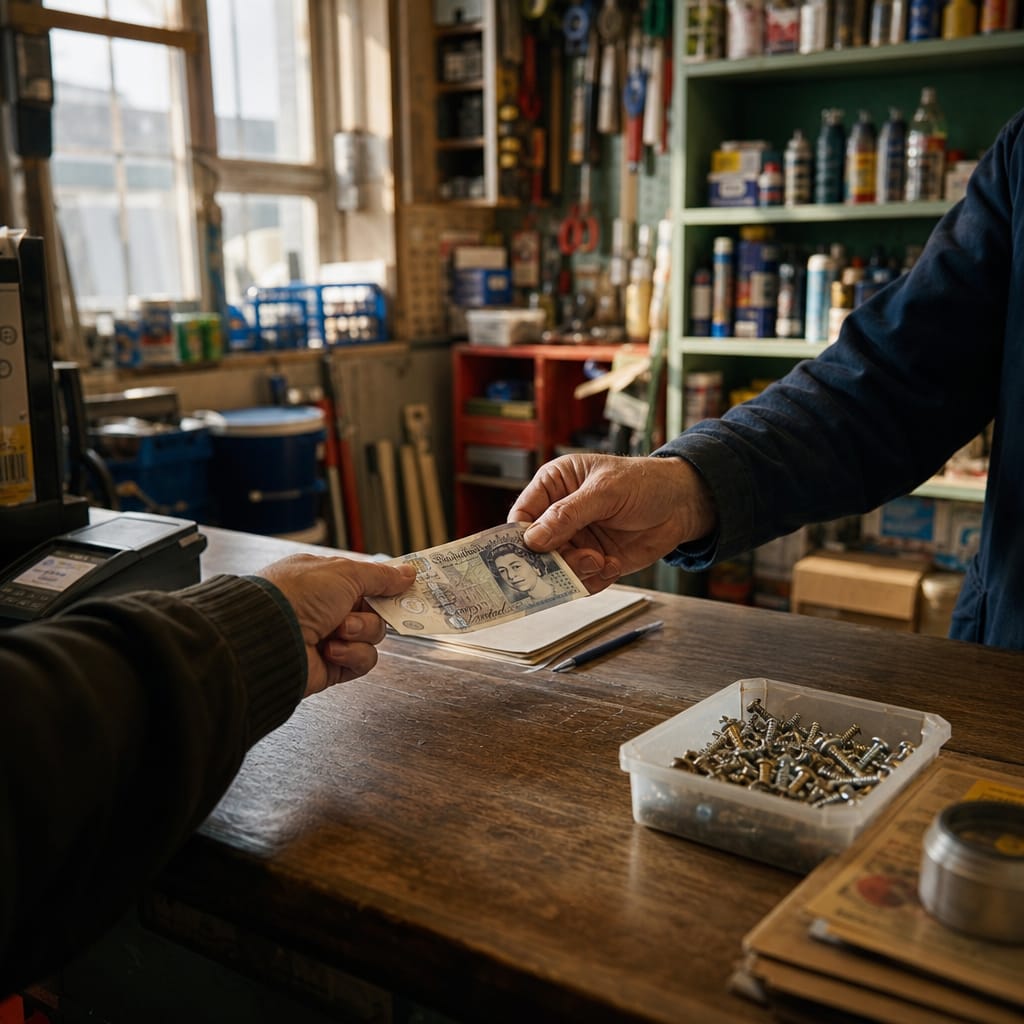
The shop owner takes your pound, and the nine others it came with. Some of that money is spent on wages, paid to someone who likely lives nearby. They will then spend some of it at the local chippy, some of it at the supermarket, some of it on the bus. Some of the money you just spent at the independent hardware shop will have been spent on stock, ordered from a supplier, who employs a driver, who fills up at the local petrol station. Some of the money will have been spent on the shop's rent. That is probably paid to a landlord who lives in the same town.
Your saved pound has become income for several people within a fortnight or so. That money that you spent circulates locally before it eventually leaks out. Economists describe this as the “multiplier effect” – not the most aptly titled concept, but there's something real behind it. Money in a savings account circulates precisely nowhere.
Where the Bank Was Sending It Instead
For the diligent saver, this is where it gets slightly uncomfortable: their money wasn’t idle in their savings account. The bank doesn’t leave their pounds alone. Banks lend – that’s the arrangement. So the money that was cautiously saved was probably out funding a mortgage, underwriting a small business loan or financing car finance for someone in a different city.
You had no say in that journey and you saw very little of the return from it. The money wasn’t idle – it just wasn’t yours, and its journey wasn’t local, and you weren’t steering it. As for the one thing the savings account told you, that the number was safe and growing, at 3.5% or whatever the current offering is, that was almost entirely a story about the number, not about the pound.
The Geography of a Spent Pound
Here's a thing that doesn't get said enough: where you spend matters to that chain in ways the spreadsheet will never capture. A pound spent at an independent coffee shop stays in the local economy at roughly twice the rate of the same pound spent at a chain. This is not because chains are wicked, but because the profits of the independent go back into the local owner's own spending and local reinvestment, while the chain's surplus travels up the corporate structure to a head office somewhere else and, eventually, to shareholders who may have no physical connection to the high street on which you bought your flat white.
None of this means "never spend at chains" – the chain employs local people too, and that wage is just as real. But it does change the geography of a spent pound, which most savers have never once thought about when deciding when to finally release the money.
The Dignified End
A kind of money-saving culture treats the unspent pound as the goal – as though the number on a savings screen is itself the point. But a pound saved is a pound deferred. Eventually it goes. The question is just what kind of journey it is on when it does.
When that money is spent on something imported and delivered from a global warehouse, it leaves the country fairly quickly. But when that same money is spent at a local market on something that was locally grown, it bounces around the town for a good while before it disappears. Neither is morally superior. But the difference is real and traceable – in the wages, the rents, the taxes paid locally, the small businesses kept open. It's just not something that an individual saver's spreadsheet has a column for.
The saved pound doesn't cease to exist the day you let it go. It just stops being yours and starts being everyone else's. Which, depending on how you look at it, might be the whole point of money in the first place.
FAQ
What happens to a saved pound when you spend it?
Your money stops being your money and becomes someone else’s income. For example, the money you spend at an independent hardware shop will be used to pay staff, buy stock, pay suppliers’ drivers and pay rent. Within a fortnight or so it will have become the income of several individuals, circulating locally before it eventually disappears out of the area.
What is the multiplier effect?
The multiplier effect is the term economists use for the flow of money within a local economy after it has been spent by a consumer. In the case of a business, that could be wages, rent or stock orders, passing the same pound from person to person, each spending some of it nearby. The article calls the name unhelpful but says that there is substance behind it.
Does money in a savings account stay idle?
No. Banks lend money. So your savings are probably being used to lend to people in other cities buying mortgages, or starting up small businesses, or buying cars. You will have no control over where your savings are lent and most likely see very little return on your investment. Savings in a savings account do not get to circulate round the local economy like the money you spend.
Is it better to spend at independent shops than chains?
Money spent in independent shops is more likely to be spent within local economies than money spent in chains of shops. Independently owned coffee shops retain roughly twice as much of a pound as chains in local economies. The fact that chain shops have a surplus that is sent to the head office of a company or to the shareholders of that company does not make money spent in independent shops morally superior to money spent in chains of shops, however, because in both cases there are people employed locally.