
There is a particular kind of holiday that nobody really talks about. Not the first holiday after having children, or the last family package before the kids were too old to pretend they were enjoying it. The one after. The one booked in the strange, flat months following a bereavement, or signed for in a solicitor's waiting room in spirit if not literally, or planned during the odd autumn after the house went quiet because your youngest finally left. That holiday – the one chosen in the gap between one version of yourself and whatever comes next.
It is almost never Lanzarote.
The Resort Was Designed for Someone Else
This is not a coincidence and it is not snobbery. All-inclusive resorts are engineered to remove friction. The pools are warm, the buffet is enormous, the entertainment timed so that silence never quite lands. This is a genuinely brilliant design solution for a family of four who need everyone pleased by six o'clock. But it requires something of the visitor in return: you have to want to be absorbed. You have to be willing to hand yourself over to the rhythm of the place.
In transitional years, people stop being willing to do that. Not out of principle – just because the self that wanted absorbing has temporarily gone somewhere else, and you are not entirely sure what replaced it yet. A resort built to please everyone quietly reveals, in those years, that it was never really pleasing you specifically. It was pleasing the role you were playing. Spouse, parent, couple. When the role is in flux, the mechanism shows.
What Quiet Coastlines Are Actually Doing
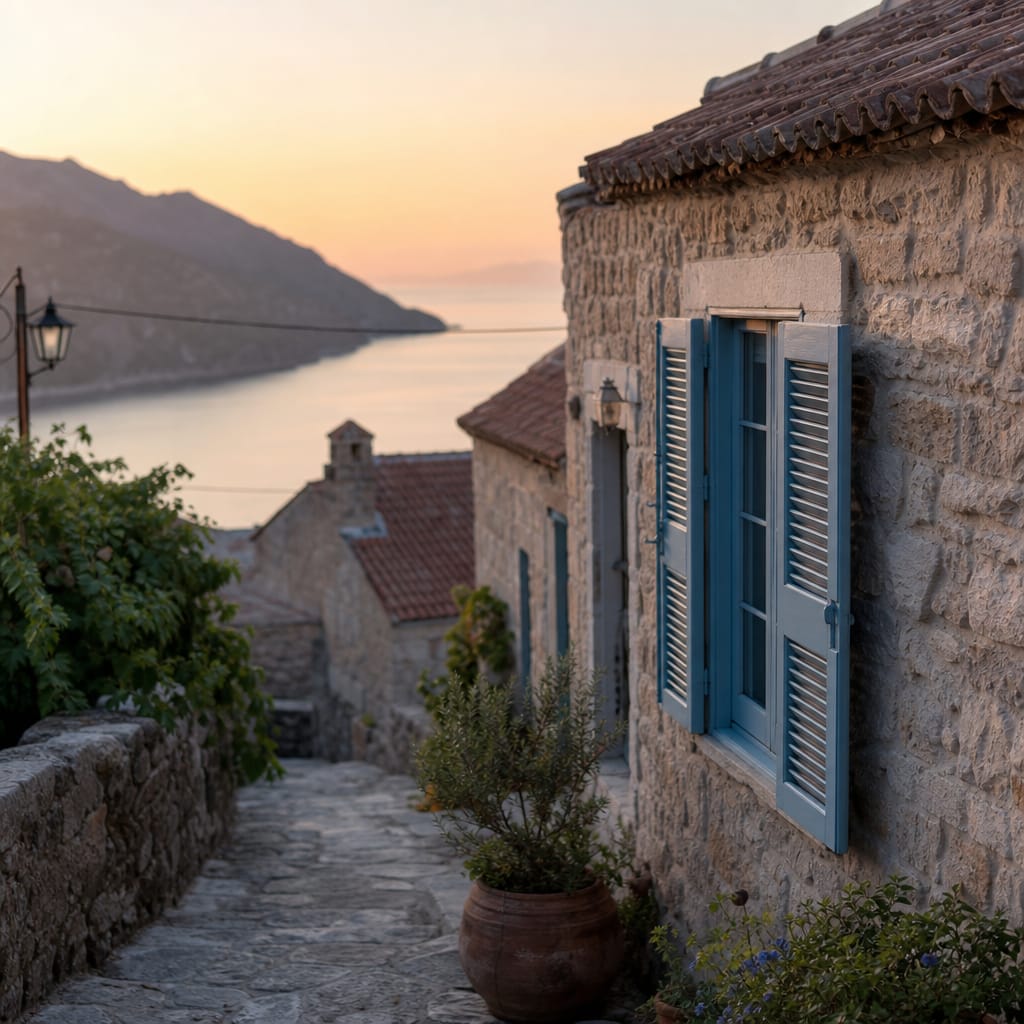
So people end up somewhere else. A fishing village in Northumberland. A guesthouse in the Outer Hebrides. A slow train through mid-Wales to a town that smells of woodsmoke. Portugal, but not the Algarve – somewhere further north, where the Atlantic is louder and the tiles are cracked and beautiful. They book it half-convinced they have made a mistake, and they arrive to find that it does not feel like a mistake at all.
What is happening there is not therapy, though people sometimes mistake it for that. What is happening is that the place has a strong enough character of its own that it asks something back from you. A coastline that is dramatic is not backdrop. You have to pay attention to it. The light changes, the scale is not in your favour, and the sea is not decorating itself for anyone. All of this turns out to be exactly what a person in transition needs – it requires you to show up as a person rather than as an occasion.
The Outer Hebrides will not adjust itself to your mood. The drive through Snowdonia does not care what you had hoped this trip would feel like. And somehow that is the relief.
Scale Starts Working Differently
One of the stranger shifts that happens in transitional travel is that scale stops meaning what it used to. Mountains and wide beaches that once felt merely impressive start feeling useful. There is something about a landscape that is genuinely large that recalibrates the problem you arrived with. Not a mystical claim – it is closer to perspective being a physical experience rather than a mental one. Standing somewhere that makes you small is not the same as being told you are small, and the body registers it differently.
This is presumably why people have always gone to the sea or the hills in difficult years. Not for the views. For the recalibration.
The Mirror Only Works When You're Not Quite Yourself
The interesting thing about all this is what it reveals about how destinations function. We tend to talk about places as if they deliver a fixed experience: Venice is romantic, Ibiza is loud, Cornwall is restorative. But places are mirrors as much as anything else, and what you see in them depends almost entirely on the particular self you brought along.
In ordinary years, the mirror is politely familiar. You see roughly what you expected. In transitional years, it shows you something else – something more specific and, often, more useful. The quietly extraordinary coastline you never noticed before. The pleasure of a place with its own agenda. The way solitude in the right setting is nothing like loneliness.
Which is perhaps why the holiday taken that year so rarely looks like the others in the album. It was booked by someone slightly different. Someone between chapters. And the destination knew.
FAQ
Why do all-inclusive resorts feel wrong after a big life change?
All-inclusive resorts expect you to want to be absorbed by them and in a transitional year this is often just what they are not getting from guests. All-inclusive resorts are designed to remove as much friction as possible from a holiday for families who need everyone pleased by six o’clock. In many cases though the self that wanted to be so absorbed by a resort has gone elsewhere and so the resort ends up serving the role you played, such as spouse or parent.
What kind of places suit a holiday during a major life transition?
This type of experience is best found in places with a strong character of their own, such as a fishing village in Northumberland, a guesthouse in the Outer Hebrides or northern Portugal as opposed to the Algarve. A dramatic coastline needs to be noticed rather than having to be dressed up for you, so you are a person rather than an occasion for that place.
Why do big landscapes help during difficult years?
The perspective afforded by large landscapes helps to re-set the problem with which one arrived. Feeling perspective as physicality rather than concept is different from being told that one is small. For a long time people have gone to the sea and the hills in times of difficulty, perhaps because such places make one feel small.
Why does the same destination feel different in a transitional year?
Places can act as mirrors for us, showing us what we expect to see, more or less, in normal times. In times of transition, however, they can be more specific and often more useful, revealing to us an unnoticed coastline perhaps, or even a sense of solitude that is not loneliness.