
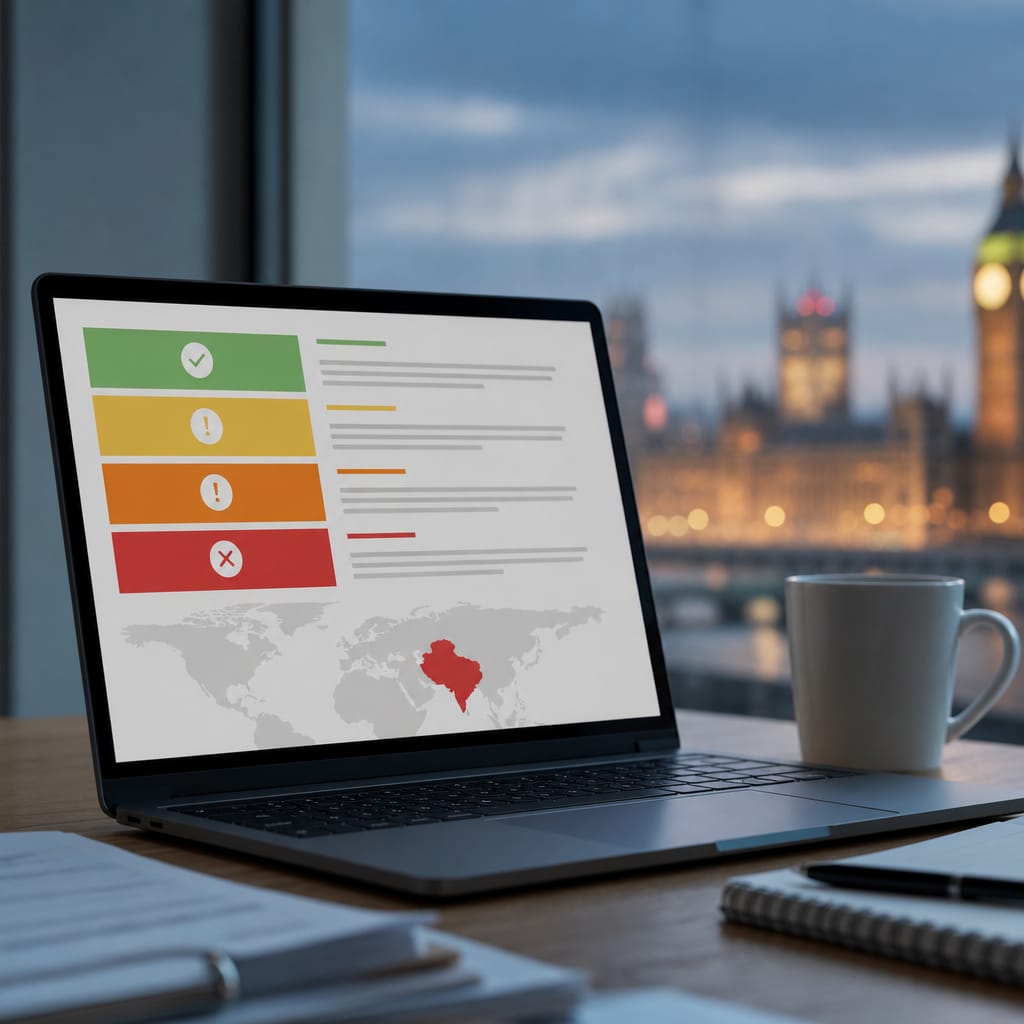
There's a page on the government's website that millions of people glance at before a holiday, decide they've understood, and close again. It's the Foreign, Commonwealth & Development Office travel advisory for wherever they're going. It looks like a traffic light. It reads like a warning label. And it's actually doing something far stranger than either.
Once you realise what those four tiers are technically saying – and more importantly, who they're saying it to – you start to see the advisory less as a safety guide and more as a piece of legal infrastructure with a colour scheme on top.
The Four Tiers, And What They're Actually For
The FCDO runs four levels of advice. “Normal precautions” is the green one – go ahead, nothing unusual to flag. “Some parts: advise against all but essential travel” only applies to specific regions within a country and not to the full country as “Advise against all but essential travel” does. The most serious advice is “Advise against all travel”.

The gap between those last two? That's where it gets interesting.
The Word "Essential" Has No Legal Definition Whatsoever
"Advise against all but essential travel" sounds strict. It suggests the FCDO is saying: only go if you really have to. A funeral. A medical emergency. Perhaps a critical business reason.
Except the FCDO does not define "essential" nowhere in its guidance — there is no official list, no panel that reviews your reason and stamps it approved. If you are travelling to a beach in a destination sitting in that tier and you consider your beach holiday essential to your mental health and general wellbeing, then the FCDO has no mechanism to disagree with you. The word is doing something symbolic rather than regulatory. It's a nudge, not a fence.
A very precise switch is flicked inside your travel insurance policy. The standard boilerplate in almost every travel insurance policy changes when a country crosses from 'normal precautions' into any flavour of 'advise against'. Some policies cancel cover entirely while others will cover your medical bills abroad but won't pay out if you cancel the trip before you go. A smaller number draw the line only at 'advise against all travel' – the hardest tier.
The Country You've Visited for Twenty Years Can Be Amber for a Decade
The advisories from the FCDO can sit unchanged for years, even decades, and bear no obvious relation to the actual situation on the ground in a given town or resort.
Some regions of Spain, France and Portugal have at various points carried some form of partial FCDO advisory, usually related to petty crime, protests or occasional civil unrest in a city centre several hours' drive from where you're staying. The advisory covers the country, or part of it. Your hotel is, statistically, just a hotel.
The foreign ministries and the insurers read this language as much as anyone packing a bag, partly because the advisories are doing diplomatic work as well as safety work. A downgrade of a country's rating can be read by the government of that country as a public statement of confidence – or its absence. An upgrade can signal a warming of relations, quietly.
Why "Advise Against All Travel" Lands Differently
The hardest tier is a different beast and moves the legal furniture. When the FCDO says “advise against all travel” to a destination, most insurers won’t cover a trip booked after that advisory was issued, full stop. Some will also void cover for trips booked before, depending on the policy wording.
At the “advise against all travel” tier, airline and tour operator cancellations are more likely, which means you’re more likely to get a refund simply because the trip stops existing. That’s not the FCDO protecting you exactly – it’s a cascade of commercial decisions that the advisory sets in motion.
When trying to make a decision before a holiday, the colour matters far less than the specific wording. And the wording itself matters far less than what your specific policy says about that wording. Reading the FCDO page and the first page of your insurance document as one thing, rather than two separate things, will tell you considerably more than either does on its own.
An advisory is a legal signal dressed up as a map. It is worth knowing what it's signalling, and to whom.
Questions people ask about FCDO advice and travel insurance
What if the advice changes after I have booked?
Check your policy’s cancellation section first. Many policies will pay out for cancellation if the FCDO starts advising against travel to your destination after you booked and bought your cover. If you book, or buy the policy, after the advice is already in place, you are usually not covered for that reason, because the risk was known when you bought. The exact wording differs from one insurer to the next, and some treat ‘all but essential travel’ differently from ‘all travel’.
Am I covered if I travel against FCDO advice?
Usually not. The government’s own travel insurance guidance warns that travelling to a destination where the FCDO advises against all but essential travel, or all travel, may invalidate your insurance. Insurers generally look at the advice in force on the date you travel. A small number of specialist insurers cover travel to high-risk places, mostly for people such as journalists and aid workers, but these are not standard holiday policies you will find on a comparison site.
Does a change in FCDO advice mean my airline or hotel must refund me?
Not on its own. If you booked flights and a hotel separately, the advice changing does not by itself give you a right to a refund. You depend on whether the airline actually cancels the flight, and on each company’s own terms. A package holiday is different. Under the Package Travel Regulations you can cancel without paying a termination fee if unavoidable and extraordinary circumstances at the destination significantly affect the holiday, and FCDO advice against travel is widely treated as strong evidence of that.
Can Section 75 help?
Sometimes. If you paid for something costing more than £100 and up to £30,000 on a credit card, Section 75 of the Consumer Credit Act makes the card provider jointly liable if the trader breaks the contract or misrepresents it. It will not help simply because the advice changed while the airline or hotel is still ready to provide what you paid for, but it can help if they cancel and then fail to refund you.