
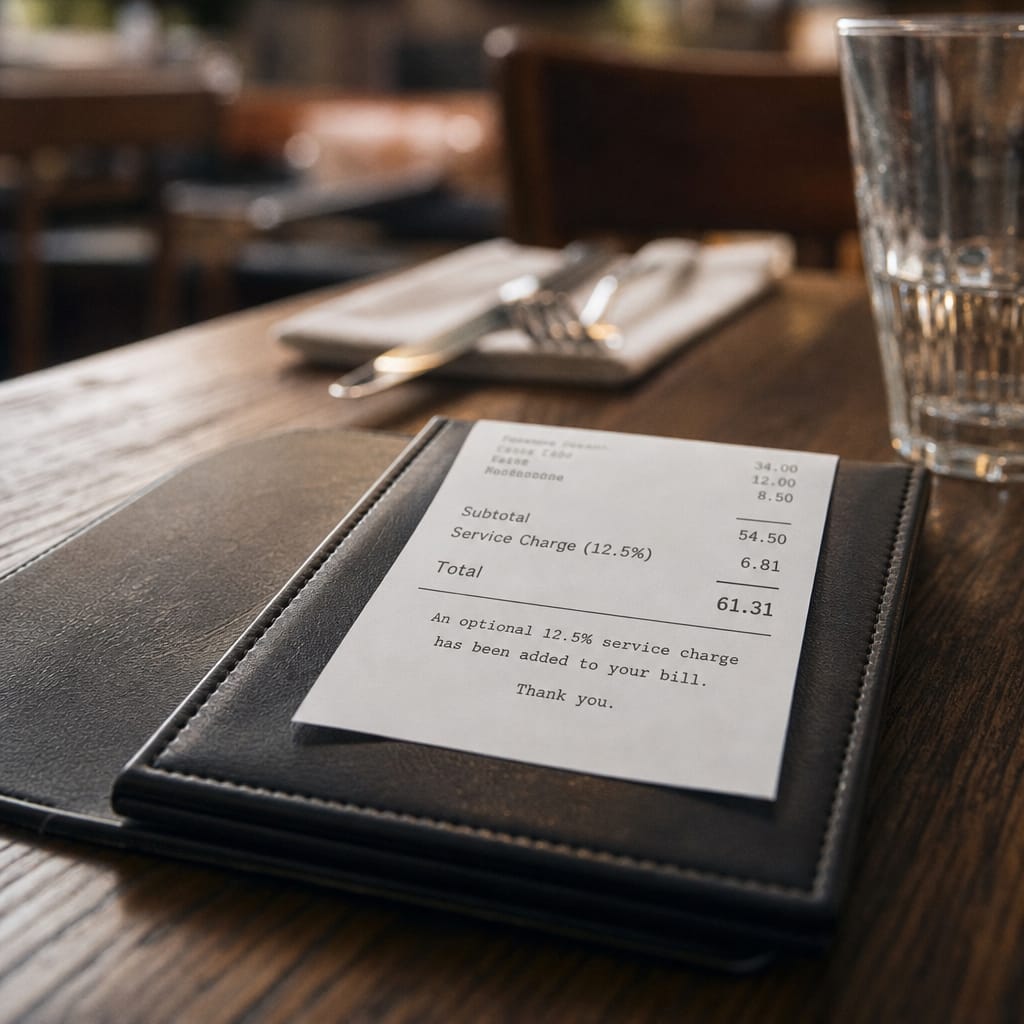
About a decade ago, a quiet ritual started happening in British restaurants. The card machine turns up, you look at the total on the bill and there it is – an "optional 12.5% service charge" already sitting there, as if it was always there. Whether or not to remove it is a slightly uncomfortable decision.
The service charge was supposed to end all of this. No awkwardness, no guessing, no fumbling with coins. It was the rational, grown-up solution to the grubby business of tips. And it nearly worked.
How Britain Decided Tips Were a Bit Embarrassing
In the late 19th century, American tourists and American culture brought tipping to Britain. It was controversial almost immediately. Labour campaigners argued it was demeaning – turning workers into supplicants who performed extra warmth in exchange for the possibility of a few extra coins. Restaurant owners thought it chaotic and unpredictable. And as for the people who received the tips, they weren't entirely sure they liked what it said about their situation.
On the Continent, there was a cleaner answer. France and other European countries had been adding a fixed service percentage directly to the bill for decades. 'Le service compris' – service included. No performance required, no decision left to the customer's mood or generosity. The money was collected, distributed, done. Hospitality was treated as work, and not as theatre.
This model was adopted by British restaurants from the 1950s onwards, with some enthusiasm. The service charge felt modern, fair and mercifully free of theatre. By the 1970s a 10% or 12.5% addition was common enough that you'd see it printed on menus without any fuss. The idea was simple: wages are wages, service is service, and neither one depends on whether the customer happens to be feeling generous that Tuesday.
Why the Service Charge Made Perfect Sense
The service charge therefore solved a problem – tips are random. On any given night a waiter could go home with wildly different amounts for doing exactly the same job, depending on whether their tables were having a good night, whether the bill happened to be large, whether the customers were American. The service charge smoothed all of that out, and also meant that the kitchen – where the cooking actually happens, but where staff are invisible and therefore untippable – could share in the pot.
On paper, this is obviously better than tipping. It’s predictable for staff and correlates with revenue, not with the vibes of individual customers. It removes the low-level coercion that tipping can put on a service interaction, where everyone secretly knows that the warmth being shown might be commercially motivated. A service charge says: we’re all professionals here. The cost of service is in the price. Now we can just move on.
How the Tip Survived Anyway
The service charge has become the thing people distrust. Not because it's irrational – it isn't – but because of a creeping suspicion, well-founded in many cases, that the money doesn't always reach the staff it's meant for. The laws on service charge in the UK have been muddled for a long time and even the rules on how you have to distribute the revenue from service charge are relatively recent. For a long time there was nothing to stop restaurants from pocketing it. And some restaurants did.
In its chaotic and inconsistent way, the tip is direct. It goes to a person (or you assume it does), bypassing the institution entirely. Inefficient, irrational, sometimes frankly unfair, but it feels like it goes where you meant it to go. That emotional logic, however imperfect, proves to be more powerful than the rational case for the fixed charge.
Where the service charge bet on trust in the business and lost it, the tip bet on the human moment at the table and, messily and inconsistently, held on.
The Uncomfortable Bit at the Bottom of the Bill
What the current awkwardness around service charges reveals is that neither system fully works on its own. The charge without transparency is just a mystery surcharge. The tip without structure is just chaos with manners painted on top. The restaurant industry of the mid-20th century looked at tipping, decided it was the problem, and built something more logical to replace it. They weren't wrong about the logic. They just couldn't quite guarantee the honesty.
The card machine arrives. The 12.5% sits there. And you make your small decision, caught between two imperfect systems that have been arguing with each other for about a hundred years.
FAQ
Why did British restaurants introduce a service charge?
A fixed percentage added to the bill was the creators’ way of offering a fairer, more predictable alternative to tipping. The continental system adopted from the 1950s allowed for smoother takings than the night-to-night up-and-down of waiting for individual tips. Moreover, hidden, untippable kitchen staff would get to reap some benefit from the till.
Why do people distrust the service charge?
Many diners fear that money allocated to staff does not always reach them. UK rules as to how the income from service charge is to be distributed amongst staff have been muddled for years and only relatively recently laid out clearly. Until recently there was nothing to stop restaurants keeping the lot and some did.
Why did tipping survive despite the service charge?
The reason that tipping has survived is because it’s direct. The money that you give goes to a person and it goes around the business. Now, it can be inconsistent and unfair at times, but you feel it goes to where you want it to. This emotional argument has won out over the more rational argument of a fixed charge, which depended on the customer trusting the restaurant.
When did tipping arrive in Britain?
Tipping was introduced to Britain by American tourists and culture in the late 19th century. Even then it caused controversy, particularly from the labour movement who saw it as demeaning, from restaurant owners who saw it as chaotic and unpredictable, and from some people who were tipped who disliked what the money said about their situation.