
There's a moment that happens to nearly everyone, somewhere around the age of fourteen or fifteen, when you're sitting in a restaurant and the bill arrives. You've already done the maths – you had the pasta, your friend had the burger, it comes to this much each, you all chuck in the cash. And then someone's dad leans over, adds a few pounds, and says something like "always leave ten per cent." You nod. You have absolutely no idea why.
Nobody put it in a lesson. Nobody sent a memo. And yet somehow, within a few years, you will know – not just the percentage, but when to go higher, when the service charge already covers it, when the jar on the counter counts and when it doesn't. You will have absorbed an entire parallel pricing system that runs invisibly alongside the official one, applying it with the quiet confidence of someone who has always known.
Children, of course, haven't learned it yet. Not because they're mean. A seven-year-old will happily put 50p in a busker's hat. But they genuinely do not know that the price on the menu isn't the whole story – that there exists a second price, unwritten, unlegislated, and yet somehow enforceable through nothing but the faint social discomfort of not paying it.
The Rule That No One Wrote Down
What's odd about tipping is that it has all the weight of a rule and none of the official trappings of one. It doesn't appear in any law. It isn't printed anywhere. Nobody fails an exam for getting it wrong. And yet get it conspicuously wrong in a restaurant – leave nothing after a long meal with good service – and you will feel it. That low-level prickle of having done something improper. The waiter may say nothing. That almost makes it worse.
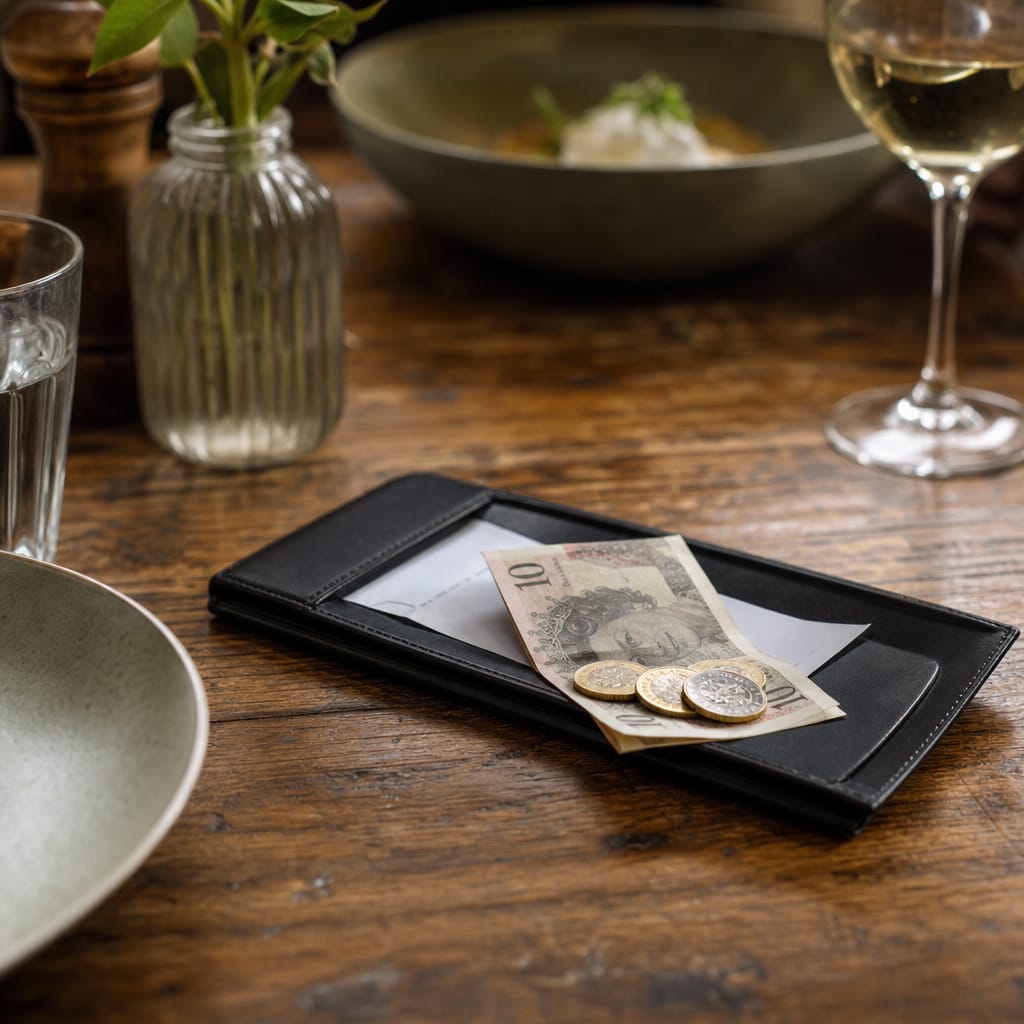
This is what makes tipping genuinely strange, as social phenomena go. It is a convention that has to be transmitted person to person, generation to generation, in whispered conversations over restaurant tables. "What should I leave?" is one of those questions that sounds like arithmetic but is actually about belonging. You are asking: have I worked out the code?
How You Learned to Read the Room
The code is more complicated than a percentage, which is why it takes years to absorb properly. Ten per cent was once the standard; fifteen has become more common; twenty is generous and signals something – either that the service was excellent, or that you want to appear the sort of person for whom twenty per cent is effortless. In a cafe, you probably don't tip at all on a coffee. At a hairdresser, you might. In a taxi, you round up. In an Uber, there's a button you may or may not press, and the awkwardness of that button is a whole essay on its own.
None of this is written anywhere. All of it is known. The way you learned it – through observation, through the occasional mortifying error, through a parent's quiet correction or a friend's raised eyebrow – is exactly how you learned a dozen other social conventions that you now follow without noticing: how loud to be in a library, when to hug and when to handshake. The fact that tipping carries the same weight as those things, despite involving actual money, tells you something about what it really is.
Not Generosity, Exactly
This is the part that takes the longest to figure out. Tipping looks like generosity because it involves voluntarily giving someone money you weren't contractually required to give. But it doesn't quite feel like generosity when you're doing it, does it? It feels more like settling a score. Completing a transaction that the menu left half-finished.
Real generosity is spontaneous. You tip even when the service was only decent, even when you're broke, even when you'd rather not – because you know the rules and you follow them. That's less like generosity and more like fluency. The way a native speaker conjugates a verb without thinking about it, while a learner has to stop and work it out.
Children can't do it because they're still in the learner phase. They haven't yet internalised the idea that some prices are suggested and some are mandatory-but-unofficial. The moment they do – the moment they pick up the bill, look at the total, and automatically start calculating – is the moment they've been fully initiated into a very particular kind of adult knowledge.
And nobody ever officially told them. They just picked it up. Like every other rule that matters.
FAQ
How much should you tip in a restaurant?
Historically, ten per cent was considered the standard rate but fifteen per cent has become the more normal tip to give, with twenty per cent being considered generous. Giving twenty per cent is a sign of either excellent service or a wish to look comfortable with generosity. Remember to check if a service charge has already been added and if so, you do not need to add further.
Do you tip in a cafe, a taxi or an Uber?
It depends on the setting, and the rules are unwritten. Some places you might not even tip for a coffee in a cafe but you might for a hairdresser’s cut. In a taxi you usually round up but in an Uber there’s a button for you to press or not to press which can feel rather awkward.
Is tipping a rule or a law?
Tipping is a social convention, which isn’t enshrined in any legislation. You won’t find any printed copies of the rules anywhere. Getting it badly wrong, such as sitting down for a long, leisurely meal with good service and leaving no tip whatsoever, can give you the feeling of having done something wrong, and the waiter may say nothing, which can make it feel worse.
How do people learn how much to tip?
Most children do not understand that there is an additional price for service on top of the advertised price of a meal. This is not because they are mean, as a seven-year-old will happily put 50p in a busker’s hat, but because they do not understand the unwritten ‘second price’ of being served in a restaurant. People typically learn about tipping by observation of others, by the occasional embarrassing mistake and by how a parent or friend might react in a situation in which a tip has not been left.