
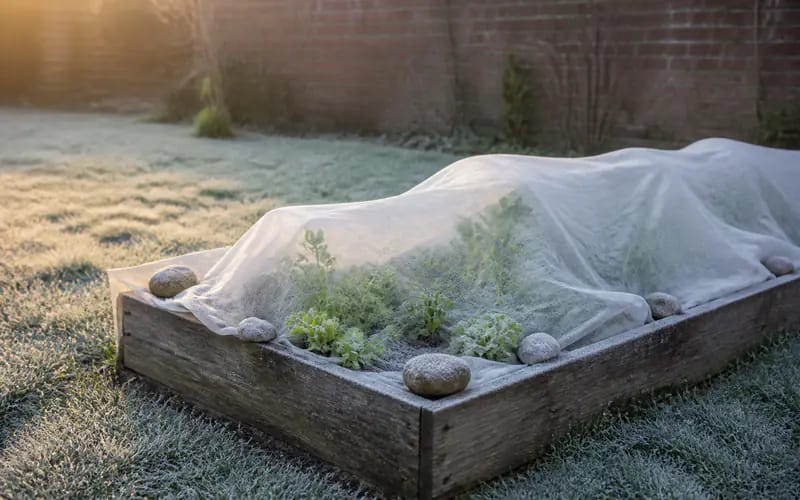
Most gardeners want to know when it is safe to move their tender plants outside in the spring. Unfortunately there is no single date for ‘last frost’. The so-called ‘last frost date’ is a long-term average date for frost-free weather and thus a poor basis for planning individual years.
What Last Frost Date Really Means
The ‘last frost date’ is actually the average date for the last occurrence of frost in a particular region, taken from many years of weather records. So it’s not a guarantee of anything. You can treat it as a rough guide for planning, but it’s always wise to check the current weather forecast for the specific area you are in before planting out tender plants to put them in the open ground.
Frost Risk Through March
For the UK as a whole March is still a cold month with on average 15 nights of ground frost and 7 nights of air frost. For gardeners with regards to planting hardy vegetables etc. in open ground it is still a time when these need to be protected by covering with fleece etc. although they can be grown in cold frames etc. Medium to tender plants and flowers should not be put out in the open ground in March.
Frost Risk Through April
In April on average there are about 12 nights of ground frost and 4 nights of air frost. As has already been noted, frost is less common in April than it is in March, and a string of clear nights can often catch out the gardener who has planted too early in the season.
Frost Risk By May
As the Met Office point out, the typical garden in the UK will experience only a couple of ground frosts in May, although this is by no means impossible. Therefore, by late May half-hardy plants can be planted out in the garden, although as ever it is always worth checking the weather forecast for a final check before planting.
Air Frost Versus Ground Frost, For Gardeners
Ground frost and air frost have very different effects on plants and so it is worth understanding the difference. Ground frost occurs when grass and soil temperature falls below freezing. Although the air temperature may be only slightly below freezing it can still cause significant damage to plants. Air frost occurs when the air temperature falls below freezing. This is generally worse for plants than ground frost as it penetrates more easily into plants through the leaves. The Met Office website has a very good guide to the differences between air and ground frost and how it affects plants, but for gardeners the key point is that low growing plants such as small seedlings and newly planted crops can be badly affected by ground frost on a night when the air temperature has only fallen to just below freezing.
Why Your Garden May Run Colder
Regional averages hide great variability within a region. A frosty garden in a frost hollow or on the bottom of a slope can be up to two weeks behind average in spring, as can gardens in upland or northern parts of the country. Seasonal average temperatures for the UK are given on the Met Office website and demonstrate the great variation between north/south and upland/valley locations. However, within a garden there can be great variation between different parts of the plot. The coldest area will lose its morning frost last and will tend to be up to one week behind average in spring.
What To Plant Early And What To Wait For
Hardy vegetables and sweet peas can be planted from March in a variety of ways, including under fleece or in cloches. Half-hardy plants such as tomatoes, courgettes and bedding plants are from warm climates and will be killed by a single frosty night. So they need to be planted when the risk of frost has dropped to zero, which is late May in most parts of the UK. The Woodland Trust gives a guide for best time to plant trees for different parts of the country but the rest of the season is similar to this.
Reading The Forecast For A Borderline Night
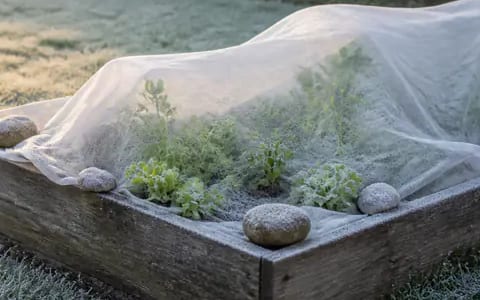
However, even when the risk of frost has decreased to the point where the average date for the last ground frost has passed it doesn’t mean that there will be no risk of frost at all. In fact a cold, clear night with still air and dry air can see temperatures drop very quickly indeed. In late spring a cold, clear night with still air and dry air can see the temperature drop by as much as 5-7°C in just a few hours. This sort of night is classic frost and even in late spring it is worth checking the forecast for your area to see if such a night is approaching.
Protecting Plants On A Risky Night
Loosely draped fleece can trap a little bit of warmth in around the plants, is cheap to buy and reusable. Cloches are also a good option, protecting individual plants or short rows of beds. Pots and containers can be easily moved into a cold porch, shed or even unheated greenhouse for the night and then returned outside when the danger has passed.
Decision Framework
Hardy vegetables and sweet peas: Plant out from March, using fleece to cover the plants.
Half-hardy bedding plants, such as pelargoniums and exotics, as well as tomatoes and courgettes: plant out towards the end of May in most parts of the country.
A frost hollow, a north-facing slope, or an upland or northern garden: allow 1-2 weeks to mature and take full account of the late start.
Clear, still, dry nights (even in late spring) are potential frosts and need to be covered (using fleece) or brought into a safe place such as a cold garage, porch or greenhouse for the night and returned to the garden the following morning.
So don’t rely on the average weather data to determine when to plant and what to protect in your own garden. Use the averages to set up a starting point and then go with the way your own garden normally behaves and use the latest weather forecast to make any necessary decisions.